Monday, August 29, 2016

Why do big US companies take mobile less seriously than Chinese companies?

If you want to know how seriously any public company takes mobile, then take a look at the annual/quarterly reports.


While top Chinese retailers, banks and internet companies are keen to share their mobile success with their investors, their US equivalents are often shy to reveal their numbers… especially the biggest US retailers.


While researching a series of in-depth m-commerce reports for ClickZ Intelligence, I needed to establish which of the world's biggest countries are really making headway with mobile. The results are worth sharing.


The methodology was simple


1) Use Forbes' Global 2000 as a guide.


2) Stick to US and Chinese companies (as they dominate the Forbes list).


3) Concentrate on consumer facing businesses where mobile isn't the core business, but should be a very significant sales channel, so retailers, restaurant chains, banks and internet companies are in; but mobile companies and oil companies and manufacturers are out.


4) Then check the latest annual (2015) and quarterly statements (Q1 and Q2 2016) to see which detailed mobile performance – only hard numbers; PR fluff was ignored.


The results were striking:


  • The top Chinese banks, retailers and internet companies all (of those considered) detail mobile performance, often in considerable depth.

  • Three out of four top US banks declare mobile numbers. But not in as much detail as the top four Chinese banks.

  • Of the two US internet giants, only one details mobile performance: Facebook. Alphabet (Google), surprisingly, doesn't.

  • Not one of the Top 10 US retailers from Wal-Mart to Amazon.com, shared mobile stats in their recent annual or quarterly report.


The US retailers were a big shock – especially Amazon. In 2016, you have to ask: why we couldn't find any indication of mobile performance in financial reports of the US top retailers?


And, more importantly, you have to ask: why aren't investors and analysts asking the same thing?


The more financial reports you look at the more you come to the conclusion: Chinese companies – and their investors – take mobile more seriously.


They saw the mobile opportunity earlier; they made it a priority to re-engineer their companies to take full advantage; and now they want investors to benchmark them on their impressive mobile performance.


Alibaba: the benchmark in mobile performance and reporting


This month the Chinese ecommerce retail market place Alibaba redefined what it means to be “mobile first” announcing that it has 427 million mobile monthly active users (MAU) – out of a total of Alibaba's 434 million total users.


In the latest quarter (Q2, 2016), mobile accounted for a stunning 75% of value of all goods bought and sold on the platform and 75% of its revenues.


Just to put Alibaba's 427 million mobile users into perspective:


  • The entire population of the US is 324 million.

  • Walmart's global customer base 260 million (Note: Walmart measures weekly shoppers; Alibaba's are monthly).


ali baba quarterly figures


The wake-up call for all companies is twofold


  1. A mobile-first strategy delivers tangible rewards.

  2. How well the markets received the news…


Financial investors and analysts loved Alibaba's results. On announcement of the Q2 results, the stock leaped to its highest level for 18 months.


This is the carrot: impressive mobile performance is increasingly a factor (one of several) that encourages investors to purchase stock.


The question is: when will US investors / analyst start to use the stick to punish (US) companies that keep their mobile numbers a secret?


US investors are becoming well acquainted with, and increasingly attracted to the Chinese retail and internet companies such as Alibaba, JD.com, Baidu and Tencent (all of which detail impressive mobile performance in their financial reports; all of which saw their share price improve on the latest results.


Three out of four are quoted on US markets: Alibaba is listed on the NYSE; JD.com and Baidu on Nasdaq (Tencent is listed on HKSE), which means they'll remain front of mind.


For share price performance, see: BABAJDBIDU; and 0700.HK (Tencent).


Stick and carrot – Facebook's mobile story


Any US company that doesn't believe how seriously US investors take mobile needs to look at Facebook's recent financial history.


One of the main reasons Facebook's share price went into freefall post its 2012 IPO was that investors were very unimpressed with its mobile story. One of the main reasons they love it now is because they are impressed with its mobile numbers.


As recounted by Fortune in 2015:


Facebook used its weakness on mobile as a motivator. When the company went public it had no meaningful revenue from mobile. Within 18 months, Facebook delivered a magnificent about-face on mobile, quieting the haters in the process. By the end of 2013, more than half of Facebook's revenue came from mobile ads. “You want mobile revenue? We'll show you mobile revenue!” the company seemed to say. Wall Street rewarded the company by trading up its stock.


Today Facebook wants to be measured on its mobile record. In its Q2 2016 results statement it couldn't shout louder about its mobile success:


Second Quarter 2016 Operational Highlights


  • Daily active users (DAUs) – DAUs were 1.13 billion on average for June 2016, an increase of 17% year-over-year.

  • Mobile DAUs – Mobile DAUs were 1.03 billion on average for June 2016, an increase of 22% year-over-year.


Second Quarter 2016 Other Financial Highlights


  • Mobile advertising revenue – Mobile advertising revenue represented approximately 84% of advertising revenue for the second quarter of 2016, up from approximately 76% of advertising revenue in the second quarter of 2015.


The phenomenal rise of Facebook's stock price, see FB, from mid-2013 tells you everything you need to know about investor attitude to mobile.


How the largest companies rack up on mobile transparency


By way of research we looked at the recent annual and/or quarterly reports and earning statements of relevant companies from the world's biggest public companies according to Forbes, which is dominated by Chinese and US companies, to see to what extent (if at all) mobile performance is displayed.


The Forbes rankings are based on a mix of revenue, profits, assets and market value.


Chinese banks:


Three Chinese banks occupy the top three Forbes rankings, with a fourth in sixth ranking. All four appear to have made mobile banking a priority over recent years and the numbers are staggering. At the end of 2015, they have 590 million mobile banking customers between them. That's 1.8 times larger than the population of the United States.


  • Industrial & Commercial Bank of China has 190 million mobile customers, with annual transaction volume of over RMB800 billion (US$121 billion), which is approximately 38% of its customer base. (Source 2015 Annual Report)

  • China Construction Bank has 182.84 million (up by 25% year on year) mobile banking users, with a transaction volume was RMB15.4 trillion (US$2.3 trillion), which is approximately 54% of its customer base. (Source 2015 Annual Report)

  • Agricultural Bank of China has 140 million mobile customers, with annual transaction volume of over RMB9.6 trillion (US$1.5 trillion), this is approximately 29.5% of customer base. (Source 2015 Annual Report)

  • Bank of China has 79 million mobile customers, with annual transaction volume of over RMB5.2 billion (US$0.7 billion), the proportion of the customer base that is mobile is unclear. (Source 2015 Annual Report)


US banks:


Three of the top four US banks share mobile banking numbers. Although mobile customers are dwarfed by the vast numbers of their Chinese counterparts are a significant proportion of their total user base.


  • JP Morgan Chase (Global Rank 5) has 24.8 million active mobile customers. As JPMC only counts its customer base by households (59.2 million), rather than individuals, it is unclear what proportion of customer are mobile. Mobile transaction value is unavailable. (Source Q2 2016 results).


  • Wells Fargo (Global Rank 7) has 18 million mobile active users. This is approximately 25.7% of customer base. Mobile transaction value is unavailable. (Source Q2 2016 results)


  • Bank of America (Global Rank 11) has 20.2 million active mobile banking customers in Q2 2016. It is unclear what proportion this is of the total customer base. But it does reveal in its investor presentation that mobile equates to 17% of total deposit, and on a weekly basis it is the most active channel. See charts below. (Source Q2 2016 results)


  • Citigroup (Global Rank 13). We were unable to find mobile numbers for Citigroup, but the company did state in its 2015 Annual Report that it is implementing a “mobile first” approach via a newly established Citi FinTech unit.


Brian Moynihan Chairman and CEO, Bank of America explains to shareholders why mobile banking is so important:


Why are we tripling our investment in 2016? It is simply because this is how customers want to do business with us. Our customers deposit 250,000 checks a day through their mobile devices, reflecting 15 percent of consumer deposit transactions. We would need an additional 650 financial centers to handle the deposit activity that is currently being done on those mobile devices.


bank of america figures


Chinese retailers:


China's highest ranking retailers on Forbes list are Alibaba (rank 174) and JD.com (rank 800). Despite their lowly ranks, compare to US companies such as Walmart (rank 15), these are no small fry.


  • Alibaba is an internet marketplace where third-party retailers sold RMB 837 billion (US$ 126 billion) of goods in Q2, 2016. (That's six times the value of goods sold on eBay in the same quarter). As noted above, 75% of this GMV and 75% of the revenue it makes from these sales. Total revenue is RMB 32.2 billion (US$ 4.8 billion), which means Alibaba's revenue from mobile is


Most interesting is the news that Alibaba now makes more money from each of its 427 million mobile user than from non-mobile customers. (Source Q2, 2016 results)


  • JD.com is a direct ecommerce retailer and internet marketplace, it makes more in revenue than Alibaba, at RMB 65.2 billion (US$9.8 billion), in Q2, 2016, hence its claim to be “China's largest ecommerce site by revenue”. But GMV (value of total goods sold) is lower than Alibaba at RMB160.4 billion (US$ 24.1 billion), though still slightly above eBay.


Unlike its rival, JD does not reveal what proportion of revenue or GMV is mobile or the number of mobile users. But it does declare that an impressive 79% of its orders placed on mobile. (Source: Q2, 2016 results)


Like its rival Alibaba, JD's earnings were well received by investors.


dna28_jd.com_mobile_share


US retailers:


Compared with the mobile details (and outstanding mobile performance) shared by the Chinese retailers, the details shared by US retailers is disappointing.


Searching through the 2015 annual report and quarterly earnings statements (up to August 18 2016), we were unable to find mobile performance numbers of any descriptions for the following US retailers and restaurants.


  • Wal-Mart Stores (Forbes rank 15)

  • CVS Health (rank 62) – no mobile numbers apparent in 2015 annual report, Q1 or Q2 2016 reports.

  • Walgreens Boots Alliance (rank 107)

  • Home Depot (rank 112)

  • Target (rank 164)

  • McDonald's (rank 189)

  • Costco Wholesale (rank 192)

  • Lowe's (rank 205)

  • Kroger (rank 223)

  • com (rank 237)

  • The Priceline Group (rank 445)

  • Macy's (rank 515)


There were two US retailers/restaurants sitting outside the top 10 that revealed some details of mobile performance:


  • Starbucks (Forbes rank 389) reveals the adoption of mobile ordering and payment by customers. In Q3 2016 Mobile Order and Pay usage reached 5% of the coffee chain's U.S. transactions, up from 4% in Q2 FY16. (Source Q3, 2016 results)


  • eBay (rank 466) does not include details of mobile performance in its actual earnings releases, but in an accompanying “Fast facts” document it declares that $9.5 billion of sales on the auction site were completed on mobile devices in Q2 2016. This means mobile sales volume is now 45.5% of the GMV for the quarter ($20.9 billion). eBay also states that 57% of sales are touched by mobile at some point. (Source eBay Fast Facts – PDF).


Chinese internet companies


There are two prominent internet companies in China, Tencent Holdings (Forbes rank 201) and the Baidu (rank 349):


  • Tencent businesses include the QQ web/mobile portal, instant messaging and gaming platform, the Qzone social media site and the Weixin/WeChat social/chat smartphone application. As of June 2016, Mobile QQ has 667 million monthly active users (MAU) users, Qzone has 596 million MAU and Weixin/WeChat has 806 million MAU. Mobile's contribution to revenue is not available, except reporting that smartphone games delivered RMB 9.6 billion (US$ 1.4 billion) in revenue (Source Q2, 2016 results)


  • Baidu is a mobile/web search engine, with portfolio of associated products. In its Q2 2016 results it reported it had 667 million mobile search MAU and 343 million mobile maps MAU. Total or online MAUs were not reported. Mobile revenue represented 62% of total revenues for the second quarter of 2016, compared to 50% for the corresponding period in 2015. This works out at RMB 11.3 billion (US$ 1.7 billion). (Source Q2, 2016 results)


US internet companies


The two prominent Internet companies in USA are Alphabet, the company formally known as Google, (rank 27) and Facebook (rank 188). The contrast is remarkable.


  • Facebook now has over 1 billion (1.03 billion) mobile daily users (DAU), which is 91% of total DAU. Mobile advertising revenue accounts for 84% of total ad revenue (US$ 24 billion) which means Facebook earns US$ 5.24 billion in mobile ad revenues.


  • Alphabet does not report mobile numbers in its 2015 annual report or 1Q or 2Q 2016 reports. It appears from the investor earnings calls that mobile is very important to Google, which makes it inexplicable that the company does keep investors informed of mobile performance. (Source Q2, 2016 results and earnings call)


Sundar Pichai, CEO Google, investor briefing Q2 2016:


“Q2 2016 earnings call: Our investment in mobile now underlines everything that we do today from search and YouTube to Android and advertising. Mobile is the engine that drives our present.”


Room for improvement


We look forward to the time when US companies feel confident enough about their mobile numbers to share them in their financial reports; or the time when investors start to insist on it.


N.B. This study was not an in-depth research project, it was based on observations from the companies' financial reports. If any of these retailers share numbers elsewhere / or would like to share their mobile numbers, please contact the author Andy Favell who will be very happy to update the ClickZ readers.


Read the reports:


This is Part 28 of the ClickZ 'DNA of mobile-friendly web' series. Here are the most recent chapters:


Andy Favell is ClickZ columnist on mobile. He is a London-based freelance mobile/digital consultant, journalist and web editor. Contact him via LinkedIn or Twitter at Andy_Favell.

Friday, August 26, 2016

Why Every Website (Not Just Local Sites) Should Invest in Local Links and Citations - Whiteboard Friday

Posted by randfish

At first glance, local links and local citations might seem unnecessary for non-local websites. On a closer look, however, there are strong underlying benefits to gaining those local votes of confidence that could prove invaluable for everyone. In today's Whiteboard Friday, Rand explains why all sites should consider chasing local links and citations, suggesting a few different ways to discover opportunities in your areas of focus.


Click on the whiteboard image above to open a high-resolution version in a new tab!

Video Transcription

Howdy, Moz fans, and welcome to another edition of Whiteboard Friday. This week we're going to talk about why websites - every website, not just local websites - should be thinking about tactics and a strategy to get local listings and local citations.

Now, this might sound counterintuitive. I've actually encountered a lot of folks - especially online-only businesses or even blended online and local businesses - who think, "Are local links really that important to me, or are they off-topic? Could they potentially cause problems and confusion? Should I be trying to get those?" I'm going to try and make the case to you today that you absolutely should.

Recently, I got to visit Scotland to talk to several folks. I visited Skyscanner. I spoke at the Digital Excellence event and spoke, of course, at the Turing Festival, which was a remarkable event in Edinburgh. We actually landed in Glasgow on a Saturday and drove up to a little town called Inveraray. So I'm going to use some examples from Inveraray, Scotland, and I apologize if my accent is miserable.

A few of the businesses we visited there: Loch Fyne Whiskies, they have their own living cask, where they essentially add in whiskies and blends to this cask that keeps evolving; Whisky Shop, which is an online-only shop; and then Inveraray Castle, which is a local business, entirely a local business centered around this lovely castle and estate that I think, if I understood correctly, is run by the Duke of Argyll, Argyll being the region around there. Apparently, Scotland still has dukes in business, which is fantastic.

Local & online business


So for a local and online business, like Lock Fyne Whiskies, they sell whiskies in their specific store. You can go in - and I did - and buy some stuff. They also sell on their website, I believe just in the United Kingdom, unfortunately, for those of you watching around the rest of the world. But there are certainly reasons why they would want to go and get local links from places that link to businesses in Inveraray or in Argyll or in Scotland as a whole. Those include:

  • Boosting their Maps visibility, so that when you're searching in Google Maps for "whisky" or "whisky shops," potentially, if you're near Inveraray, Google Maps will make their business show up higher.
  • Boosting their local ranking so that if you're searching for "whisky shop Argyll" or "whisky shop Scotland" or "whisky shop near me" and you happen to be there, Google will show this business higher for that ranking as well.
  • Boosting their domain authority, meaning that those local links are contributing to overall ranking ability. That means they can rank for longer-tail terms. That means they can rank more competitively for classic web search terms that are not just in local or Maps.
  • Sending valuable traffic. So if you think about a listing site, like thelist.co.uk has them on there, TripAdvisor has them on there, a bunch of local sort of chamber of commerce - it's not actually the chamber of commerce there - but chamber of commerce-type sites list them on there, that sends valuable direct traffic to their business. That could be through foot traffic. It could be through referrals. It could be through people who are buying whisky online from them. So a bunch of real good reasons why a local and online business should do this.

Online-only business


But if you're an online-only business, I think a lot of folks make the case of, "Wait a minute, Rand, isn't it true that if I am getting local links and local citations, those may not be boosting my relevance, my ranking ability as much as they are boosting my local ranking ability, which I don't actually care about because I'm not focused on that?"

So, for example, whiskyshop.com, I think they are also based in Scotland, but they don't have physical locations. It's an online-only shop. So getting a local link for them in whatever part of the region of Scotland they are actually in would...

  • Boost their domain authority, giving them more ranking ability for long-tail terms.
  • Make it harder for their competitors to compete for those links. This makes link acquisition for an online-only business, even from local sources, a beautiful thing because your competitors are not in that region and, therefore, they can't go get those same links that you can get simply by virtue of being where you are as a business physically located. Even if you're just in an office space or working from home, wherever your domain is registered you can potentially get those.
  • Yield solid anchor text. There are a bunch of local sources that will not just point out who you are, but also what you do. When they point out what you do, they can link to your product pages or your different site sections, individual URLs on your site, and provide anchor text that can be powerful. Depending on how those submissions are accepted and how they're processed, some local listings, obviously, you're not going to get them, others you are.

There's one more that I should include here too, which is that...

  • Local information, even citations by themselves, can be a trust signal for Google, where they essentially say, "Hey, you know what, we trust that this is a real business that is really in this place. We see citations for it. That tells us we can trust this site. It's not spammy. It doesn't have these spam signals around it." That's a really big positive as well. So I'd add that - spam trust issues.

Local-only business


Lastly, a local-only business - I think this is the most obvious one - we know that it...
  • Boosts Maps visibility
  • Boosts local rankings
  • Boosts your long-tail ranking ability
  • Sends valuable direct traffic, just like they do to a local and online business.

Easy ways to find citation/link sources in your locale:

If you're going to go out and look for some local links, a few quick recommendations that are real easy to do.

  1. Do a search for a business name, not necessarily your business name - in fact, not your business name - anybody, any of your competitors or anyone in the region. It doesn't have to necessarily be your business. It could be someone in the county or the territory, the state, the city, the town, minus their site, because you don't want results from their site. You're actually looking for: What are all the places where their business is talked about? You can add in, if you'd like, the region or city name.
  2. Search for one local business and another one. So, for example, if I was Whisky Shop and I were in Inveraray or I were in Argyll, I could search for "Loch Fyne Whiskies" and "Inveraray Castle," and I would come back with a list of places that have both of those on their website. That often turns out to be a great source of a bunch of listings, listing opportunities and link opportunities.
  3. Google just by itself the city plus the state, or region or country, and get lots and lots of places, first off that describe that place, but then also that note notable businesses or that have business listings. You can add the word "listings" to this query and get some more great results too.
  4. Try out some tools here - Link Intersect in Moz, or Majestic, or Ahrefs - and get lots of results by plugging in two of these and excluding the third one and seeing who links to these that doesn't link to this third one.
  5. Use business names in the same fashion that you do in Google in tools like a Mention, a Talkwalker, Google Alerts, or Moz's Fresh Web Explorer and see who is talking about these local businesses or regions from a news or blog or forum or recent perspective.

So with that, I hope you'll do me a favor and go out, try and get some of those local links. I look forward to your comments, and we'll see you again next week for another edition of Whiteboard Friday. Take care.


Video transcription by Speechpad.com


Sign up for The Moz Top 10, a semimonthly mailer updating you on the top ten hottest pieces of SEO news, tips, and rad links uncovered by the Moz team. Think of it as your exclusive digest of stuff you don't have time to hunt down but want to read!

Thursday, August 25, 2016

Why mobile commerce sites should be designed for context

If you want your m-commerce project to deliver the results you're expecting, context should be front and centre of your design.


Across all industries, mobile traffic is eating into PC web traffic in a big way, even in economies which have a large installed base of consumer PCs.


But ecommerce sites aren't seeing mobile web visitors, particularly those who use smartphones, converting to mobile shoppers with the same success as PC shoppers.


As Andy Favell writes in ClickZ Intelligence's new report, 'The DNA of a Great M-Commerce Site Part 2: The 12 Pillars of Mobile Design':


“It is fair to conclude that conversions would be higher if the m-commerce experience on the web was better designed with smartphone users in mind. M-commerce sites that crack this will sell more.”


One of the most consistent mistakes made with mobile site design is a failure to take into account the differing circumstances, needs and intentions of smartphone users; in other words, their unique context.


The difference between smartphone and PC users isn't just a smaller screen size – it's a whole new set of variables.


An image of a stick person holding a mobile phone with the words


Google's guidelines for its search quality evaluators emphasise the importance of taking context into account for mobile users.


So how does context impact the way you cater for m-commerce customers, and what can you do to tailor your design to their needs?


Why design for context?


A customer using a PC to access your website is likely to be doing so in a limited number of settings. Most often they'll be at home or at work, possibly in an internet cafĂ©, or using a laptop somewhere like an airport or coffee shop.


Even if you imagine that they might be out and about, there are still relatively few plausible scenarios in which they could be logging in, and they don't differ from one another that wildly.


But with mobile, and particularly smartphones, the number of possible scenarios suddenly increases exponentially. Your customer could be travelling, working, moving around the house and multi-tasking, walking to your location, walking to a rival's location…


In each case, the context drastically alters the way in which this customer might be approaching and interacting with your site.


Andy Favell explained in a recent article for ClickZ, 'When will responsive websites respond to user context?' why cross-platform homogeneity – taking the same approach to design across differing platforms – doesn't make sense.


“Cross platform homogeneity forgets two massive things:


  • The requirements of the desktop and mobile user are often different

  • The requirements of the same mobile user (more importantly) vary depending on whether they are at home, at work, commuting, on route to the location, on site, in a rival's location and so on.


And that's just the start of it. Now consider:


  • How context varies by time of day, day of week, time of year.

  • What about the trigger that causes the visit to the site e.g. something on TV, snapping QR code in a print ad, tapping through from an email, social media etc.?”


Taking a user's context into account is considered to be a no-brainer for targeted advertising, and the conversions it delivers prove that targeting works.


Facebook has achieved great success from advertising thanks to its ability to fine-tune its adverts according to who a user is and what they might be doing.


Three smartphone screens displaying Facebook mobile advertisements in a user's news feed.Image by Bablu bit, available via CC BY-SA 4.0


Google is increasingly using the data it collects on users and their search histories to contextualise the results it provides them and make them more relevant. And programmatic advertising is currently making waves with the promise of being able to determine at high speed who to target based on digital cues received about the user.


The online world is increasingly trending towards high levels of personalisation as our ability to gather and interpret data about users improves. And for m-commerce, this also seems like the logical next step.


As Favell writes in 'The DNA of a Great M-Commerce Site Part 2':


“If adtech has the ability to target ads on mobile websites at visitors, surely m-commerce sites should use the same types of technology and listen to the same digital signals in order to prioritise the most appropriate content, offers and services, and make the user journey as easy and frictionless as possible?”


How to design for context in m-commerce


In part two of the 'DNA of a Great M-Commerce Site' report, Andy Favell gives a series of tips on how to personalise your mobile offering to users whilst not over-targeting to the point that users find it irritating. He advises:


  • Prioritising content, rather than selecting which content to show to the exclusion of others

  • Suggesting entries in search or form fields, such as postcode or ZIP code in a search box

  • If your website defaults to departments based on previous behaviour – for example, ASOS will open the men's or women's store homepage based on what the user has browsed previously – make sure it is clear how to return to the general homepage

  • Facilitating the buying process with options to save for later, save a favourite address, save a favourite meal

  • Encouraging a trust relationship by explaining how personalisation works and how it benefits the user

  • Making it easy to opt in or out of personalisation


The epitome of a personalised m-commerce experience is a site that adapts fully to user context, based on signals such as who a person is, where they are, what device they are using, what they like and what they are doing.


While there are very few examples of websites who are doing this well at the moment, the concept isn't too far-fetched.


A handful of retailers in the US have already invested in developing native apps which deliver a different experience to the user when they are away from a store versus when they are in-store.


The most innovative of these will switch to “Store mode” as the shopper enters a store location, activated by geotechnologies like bluetooth beacons.


A person uses their smartphone to scan a number of barcodes on the side of a green file folder.


A number of US retailers have personalised their m-commerce offerings with a dedicated “store mode”, which includes features such as scanning products to check pricing and availability | Image by Intel Free Press, available via CC BY-SA 2.0


DMI's 2015 'In-store Mobile Experiences' report sets out why a properly personalised in-store mobile experience can be so beneficial to retailers.


According to the report, 82% of high-income shoppers said that an improved mobile in-store experience would make the shopping experience better. And 74% of young people aged 18-35 said that they would spend more money at a store that provided an improved in-store mobile experience.


Standout performers in the US – which included Walgreens, Home Depot, Nordstrom, Walmart, Target and American Eagle among other brands – offered in-store features such as scanning products to unlock information on pricing and product availability; integrating loyalty programs into the in-store experience; in-store mapping; product recommendations; and reserving a dressing room.


These are all location-dependent personalisation features, but there are other mobile signals you can use to divine information about your user's context and tailor your m-commerce site to them in subtle ways.


In 'The DNA of a Great M-Commerce Site Part 2', Ronan Cremin, CTO of DeviceAtlas, writes:


“Apart from the really obvious one (location) there are other possibilities like detecting if a user is literally on the move or not (accelerometer), is the battery low etc. etc.


One important point about all of these contextual cues is to use them as hints rather than hard deciding factors because the cost of getting things wrong based on an incorrect assumption is high.


It's really dangerous to make assumptions about what a user wants, so I think that the best thing to do is make prioritization decisions over ordering of features rather than adding/removing features entirely.”


A picture of a smartphone tucked into someone's jeans pocket with its screen showing a low battery symbol.Subtle cues about a user's state like battery level can be used to personalise your m-commerce site | Image by Martin Abegglen, available via CC BY-SA 2.0


As both Favell and Cremin point out, it's important not to go overboard with personalisation, as too much can risk alienating the user, especially if wrong assumptions are made.


But don't let this put you off trying altogether. Context is everything in mobile design, and even small adjustments can go a long way towards creating a frictionless user experience and improving your m-commerce sales and conversions.


You can read the full ClickZ Intelligence reports here:


This article has been adapted from a post originally published on our sister website ClickZ: Why context is king in m-commerce.

Wednesday, August 24, 2016

NEW: Rank Beyond 10 Blue Links with SERP Feature Tracking in Moz Pro

Posted by Dr-Pete

From Featured Snippets to In-depth Articles to Knowledge Panels, Google SERP features have remade the search marketing landscape. After three years of planning and many months of work, I'm thrilled to announce the launch of advanced SERP feature tracking in Moz Pro, available immediately to all customers! Using the most comprehensive data set on the market, Moz Pro now provides advanced analysis of the 16 features listed below:


Try it now under the [Rankings] tab within any campaign (see screenshot below), or read on for a walk-through of the new features. New to Moz Pro? Take a free 30-day trial!


Stage 1: Awareness

At MozCon 2013, I gave a talk called Beyond 10 Blue Links, documenting the diversity of Google features surrounding organic results. Many of us at Moz felt strongly that the world of SERP features could have a profound impact on search marketers, and so we started to catalog Google's changes and collect the data to find out just how much SERPs were evolving.

In early 2014, we built a prototype to better understand how we could help customers track SERP features, but we discovered that most of our customers were unfamiliar with them. None of us knew, at the time, exactly what impact SERP features were having or how we should adjust our tactics. The idea of tracking possibly dozens of types of results was daunting, especially in an industry where most of us already wore too many hats.

So, we kept tracking the data, and we learned along with the industry. We also, I hope, contributed to that education. We built the infrastructure we knew we'd need down the road (much credit to our Silo team), even if we weren't sure when the turn in that road would come. Eventually – and in large part due to the growth of Featured Snippets – we knew that our customers were ready.


Stage 2: Acceptance

As of August, 86% of the SERPs in our 10,000-keyword tracking set had some kind of non-organic feature (a Knowledge Panel, a Featured Snippet, Rich Snippets, a Local Pack, etc.). If you count ads and shopping results, that number goes up to 97% – the days of 10 blue links are long gone.

We recently did an analysis of over 400,000 search result interactions (thanks to Russ Jones) and found that SERPs with rich features send 28% fewer clicks to traditional organic results. At the same time, many of these features, including Featured Snippets, create new opportunities for non-traditional clicks. Either way, the impact on your SEO is very real, and it's essential to understand what you're up against.

The challenge in tracking SERP features, as an SEO, is that which features matter to you can vary wildly with your niche. I've seen a single feature radically impact traffic for some sites, while that same feature may have little or no impact on others. Once you've accepted the reality of SERP features, you have to understand how the landscape looks for your own industries and sites:


One of the first things you'll see on the new SERP Features page is the overview. This graph shows the presence of features across your campaign, as well as the proportion of features that you're listed in (where applicable). At launch, we support the 16 highest-impact desktop SERP features. Click on the pull-down above the graph, and you can pull up a Trended Analysis for any feature. Good news: we've already got a 60-day history available at launch:


It's time to accept that SERP features really do exist, and dive into the details. Scrolling down, you'll see a comprehensive list of your Campaign keywords along with your current ranking, plus the features those keywords displayed the last time we checked them:


The keyword list shows all of your campaign keywords, along with their rankings and a list of icons signaling which features appeared on those SERPs. Blue icons indicate that your site appears in the feature, red icons indicate your competitor is in it, and orange icons mean that you're both listed (this might occur in multi-listing features, such as News Packs).

At the top of the page, you can narrow your list by keyword, label, location, or feature. Let's say you just wanted to see keywords with Featured Snippets. Next to the funnel icon at the top, click [+], then select "SERP Feature" and choose one from the list:


The overview graph and keyword list are both filtered now, and you can explore whatever features are most applicable to your work.


Stage 3: Opportunity

So, what do you do with this knowledge? We've developed an insights system to help you answer that question. For example, if a keyword in your campaign currently displays a Featured Snippet, and you rank in the top 5 organic results, you've got a decent shot at being able to compete for that snippet. So, we call that out:


Click on any keyword with "Insights" to see possible opportunities. At launch, we highlight keywords with Featured Snippets, News Packs, Reviews, Videos, and Site Links (if you're not currently listed in them). We hope to add more insights in the near future.


Bonus: Questions in KWE

Want to put this to the test today? Here's a way to easily start tracking Featured Snippet opportunities. Go to Keyword Explorer, enter a term, view all results, and then, in the first pulldown select [are questions]. You'll get a list of question suggestions related to your chosen search term:


Now, select the questions that interest you, and add them to your Campaign. We'll start tracking Featured Snippets and other SERP features, and soon you'll be discovering new opportunities to stand out from your competition.

Thanks to everyone involved on the Product and Design teams, and special thanks to our Silo team for putting the pieces in place over the past year to make tracking features possible. Please reach out to us with any comments or suggestions, and we hope you enjoy the new features!


Join our Launch Day Twitter Q&A Party!

Try it today and tweet questions (the occasional comment or rave also welcome!) to @Moz with #OwntheSERP. Questions will be answered in real-time throughout the day (ok, technically between 7:00 am and 4:00 pm US-PST) by one of our pros: @RandFish, @Dr_Pete, @BritneyMuller, @JontheExiled.


Sign up for The Moz Top 10, a semimonthly mailer updating you on the top ten hottest pieces of SEO news, tips, and rad links uncovered by the Moz team. Think of it as your exclusive digest of stuff you don't have time to hunt down but want to read!

How to use emojis in your marketing campaigns

Emojis have taken over a significant part of online communication, with people using them in order to express a feeling, a taste or an interest without using a long written description.


The term 'emoji' has become so popular that it was named by Oxford Dictionaries as Word of the Year for 2015, which means that we were not surprised when we noticed an increase of branded messages including emojis.


It's common for brands to attempt to be part of a trend, and some of them excel in it, but there's always the risk of trying too hard and in no relevant context.


The rise of emojis in branded messages


According to Socialbakers and its analysis of the top 500 brands, 59% of them included emojis in their tweets in 2015, while also 40% of them included them in their Facebook posts.


205782


Image source: eMarketer


Appboy analysed the brands using its service and saw an increase of 777% on the use of emojis in branded campaigns from 2015 to 2016.


Meanwhile, 92% of the online population has used emojis at least once, which proves how the small symbols turned into the new internet slang.   


Screen Shot 2016-08-21 at 14.02.36


Image source: Emogi


It's interesting to observe the reasons that people use emojis and it seems that it's not just about being fun and casual. In fact, people may use an emoji in order to improve online communication, to be understood, to add a sentiment, or simply to express themselves as fast as possible in the most appropriate way.


This becomes important for brands, as it may help them understand the motives behind the emoji use for their target audience and whether they should start adding them to their marketing messages.


use of emojis


Image source: Emogi


Should your brand use emojis?


Emojis may help a brand add a personal element to its marketing messages and create an additional appeal to its audience, but this doesn't mean that every case is similar.


Before you jump on the excessive use of emojis as a way to increase your relevance, you may need to consider:


  • How does my target audience interact online?

  • Would emojis enhance the branded message?

  • Which emojis could be more relevant for my brand?

  • Do I really know the meaning of the emojis I'm going to use?

  • How often should I use them?


Thus, the use of emojis depends on:


  • target audience

  • relevance

  • affinity

  • frequency


and it may be adjusted depending on the set content strategy, or a particular campaign.


Moreover, there's also the case of using emojis in an email marketing campaign, which leads to further debate on whether they are adding value to your message.


Once your brand is ready to include emojis in its next campaign, you might need some inspiration on the best possible uses to do so. Or else, you may need to learn from other brands' mistakes on what to avoid.


Brands already doing excellent emoji work


Domino's


Domino's has created one of the most popular emoji-related campaigns when it asked for customers to order pizza by tweeting the relevant emoji. People had to sign up through the site to enable the option of ordering through Twitter and from that point, a simple tweet featuring the pizza emoji led to an instant order, which was confirmed through a direct message.


Thus, a simple symbol was easily incorporated in their sales funnel and the audience turned into customers in the most creative way.


Tuesday, August 23, 2016

Voice UI and intelligent assistants: trends to watch out for next

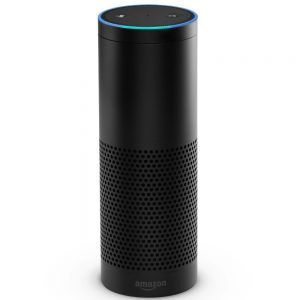
Earlier this year, a report from Consumer Intelligence Research partners (CIRP) pegged the sales of Amazon's Echo at more than 3 million units.


Echo of course uses Amazon's cloud based AI “Alexa” to answer questions, play music/games, control smart devices including home automation systems and of course re-order products off Amazon.


More importantly, awareness of this device and others like it continues to accelerate.


51XeN2UYoyL._SL1000_


In fact, according to CIRP, awareness of Echo more than doubled though the course of last year from 20% in March 2015 to more than 50% by year's end.


While an aggressive and memorable ad effort featuring Alec Baldwin, Dan Marino, and Missy Elliot may have contributed to Echo's increasing awareness and popularity, its value proposition, robust and growing functionality and perceived promise are ushering in a new era – the AI, Machine Learning and voice UI era.


Here are a few trends and predictions to look for as we prepare for this exciting wave which will most certainly become ever more present in our everyday lives and tasks.


Trends in intelligent assistants


Listening to Amazon's Charles Kindel at the Eniac M1 Summit confirms, Amazon has big plans for its cloud based omnipresent AI technology.


Those plans include how this intelligent assistant can be integrated into and can interact with other IOT devices and services be it your smart phone/watch/home, gaming/music systems and even cars, as is the case with Ford SYNC.


Clearly Amazon believes Echo and “Alexa” is so much more than just a product, it's a framework and platform that will be open to a growing number of outside developers.


Expect tens of thousands of developers to jump on the bandwagon in the coming years as they look to integrate Alexa into their own products as this technology moves quickly into the mainstream.


But don't be fooled, Amazon won't be alone and it's not the only game in town.


Both Apple with its Siri, Microsoft with its Cortana and Google with the Google Assistant and Google Home offering will compete aggressively here, particularly given their dominance on the mobile/smartphone OS front.


cortana


Given that advantage and footprint, it will be particularly interesting to see how Amazon will explore ways in which Alexa can be more deeply integrated into Apple, Google and Microsoft powered smartphones.


It should also not come as a big surprise if Amazon looks to both acquire and build solutions to support the continued adoption of its intelligent assistant Alexa.


The company's strong track record to continually experiment and innovate remains part of its culture. Bigger and bigger successes, such as AWS and Echo/Alexa, will only fuel bigger bets and experiments, and rest assured, Alexa-related investments and innovations are forthcoming.


Finally, because these voice UI's and intelligent assistants continually listen for key words and are collecting more and more info about its users to be helpful, privacy concerns have arisen.


Hopes and fears


While each company has assured users the data is not stored or shared, the always listening and learning capabilities can be unsettling.


Look for greater notice, data access and controls to be integrated into all solutions as our intelligent assistants become an increasing part of our lives.


We are on the threshold of a new era lead by AI, NL and machine learning and the emergence of the voice UI somewhat depicted in the Spike Jonze movie HER is yet another step closer to reality.

Friday, August 19, 2016

How to maximise PR outreach for site visibility in organic search

How can you earn those coveted links and mentions in news and media sites that generate an incredible influx in domain authority?


When combining SEO, PR, and content marketing, you create a winning formula for increased organic visibility, brand awareness, and social amplification.


In this article, we'll go through the steps required to create a cohesive strategy that integrates SEO and PR and maximizes the reach and outcome of both.


1.   Research & ideation


When determining the content that will resonate most with editors, journalists, and consumers, make sure you research and have as much data as possible at your disposal:


  • Who are your buyer personas?

  • What are the different stages of the buying cycle for your particular products and services?

  • Include psychographic research and data. What do they love? What are their pain points?

  • What are the keywords that each of those buyer personas typing in at each state of the buying funnel?

  • What keywords and articles are your competitors targeting to reach your target audience? With SEMrush, you can identify keywords your competitors are ranking for and traffic trends.

  • What questions are your target consumers posting on sites like quora or forums related to your products or services?

  • What content related to your industry is getting the most social amplification? Use Buzzsumo to search for related keywords, competitor contents, and set up alerts for your most relevant keywords

  • What holidays, awareness months, or special days are relevant to your audience?

  • What stories have broken that are relevant for your target audience? Trendjacking is a MUST when you are working with public relations teams.


Unless you've taken time to perform extensive research and have comprehensive data to work with, your entire amplification strategy may fail as it will not capture the interest of the journalists, bloggers, and influencers that you are trying to reach.


Segmenting audiences and crafting your editorial calendar to target each of these segments will increase the likelihood of earning media coverage.


2. Content creation


Once all of your research is completed, you have to wrap it all together into an editorial calendar. Your social, content, and press editorial calendar should be synced with each other.


If PR has identified a topic that is of interest to a journalist, this concept can be used by the content marketing team to create content for the blog, infographics, explainer videos, and social media posts. These visual assets can then be sent to the media using a press release and direct media outreach.


A 2012 study by PR Newswire found that press releases with photos garnered twice as many views as text alone. Infographics, data visualizations, live or animated videos, and reports or case studies are powerful assets used by PR teams which can be spearheaded and created by the SEO /Content Marketing team.


Whatever format you choose to use, avoid the one-and-done mentality. A survey can be used to create an infographic, which can then be turned into an animated video, which can then be shared on a blog post and used for outreach.


For our client, Teensafe, a smartphone monitoring app, we created an infographic titled the 2016 App Blacklist for Teens:


app blacklist


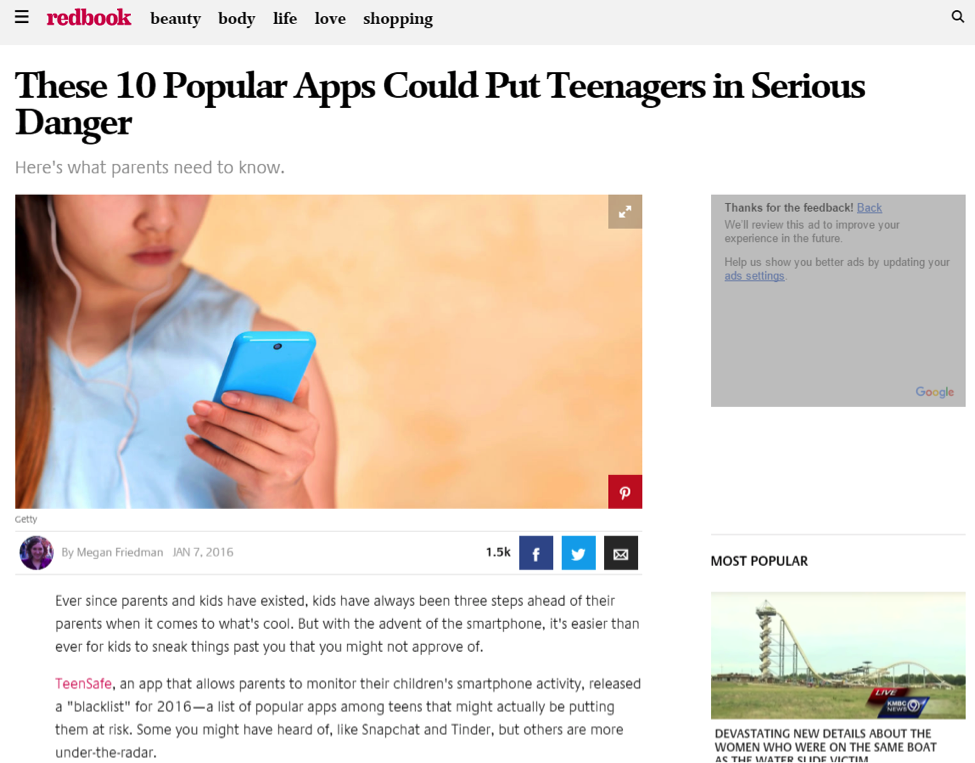
The infographic was sent out through a press release, and PR followed up with different media outlets. As a result, Redbookmag picked up the topic, creating their own post in response:


redbook webpage


At the ideation stage, both teams worked together to come up with the concept for the infographic. Once the infographic was created, the work done with PR made it possible for the piece to be placed on this, and other media websites, generating powerful links, brand awareness, and traffic.


3. PR & influencer outreach


For PR, it's important to have different content assets to use when pitching different media outlets. Some editors will resonate well with playful infographics, while others may respond to a report announcing the release of new data, while yet others may be happy to share videos.


Targeting each outlet & editor with the most relevant asset is half the battle.


Complement the media outreach with an influencer and blogger outreach campaign. To do so, use the media hits already acquired by PR.


In the example above, you can then use that link to Redbook Mag in the pitch email that you send to bloggers. Name dropping will get your bloggers to notice and want to jump on the bandwagon!


To create your influencer and blogger outreach list, use google search operators to find people who have talked about relevant topics. You can also use a tool like PressRush to help you identify the best editors or influencers to reach out to. Once again, Buzzsumo is also invaluable at this stage.


US news webpage


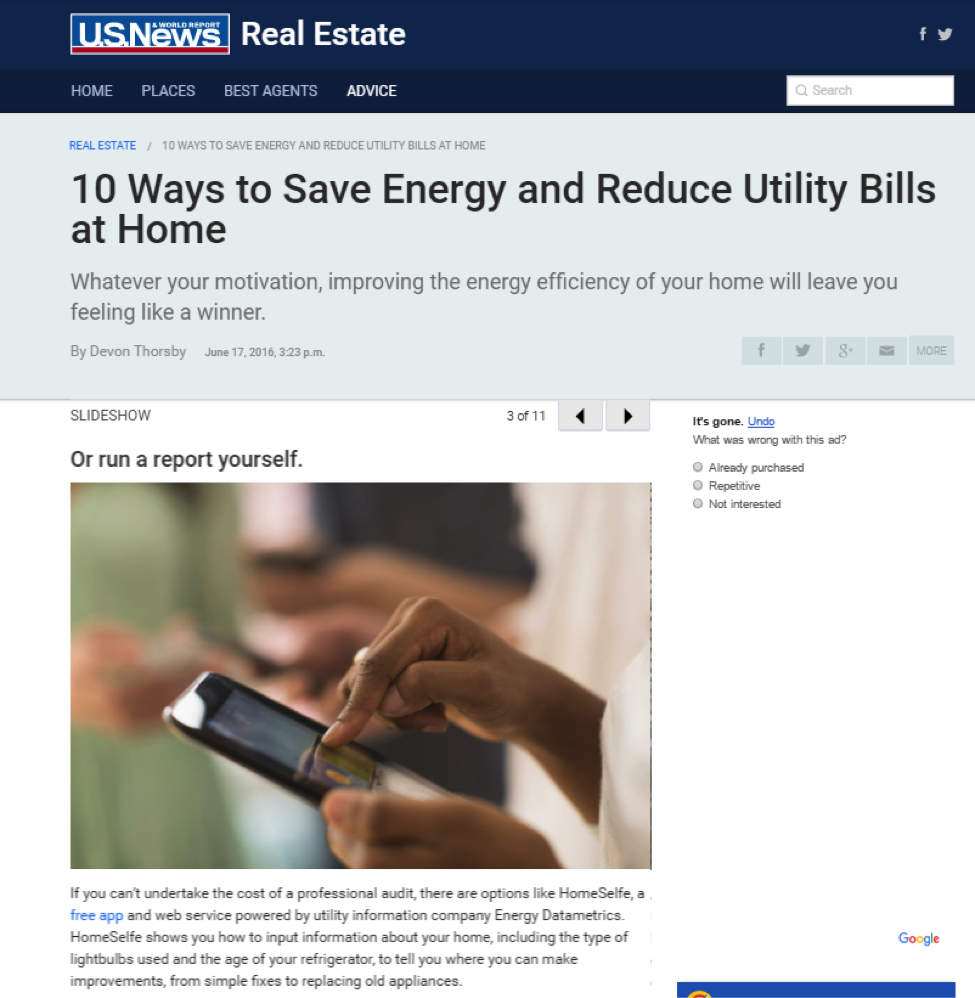
For Homeselfe, an energy efficiency app, we created a report about 10 ways that individuals can save energy and reduce utility bills. US News ran with it, featuring Homeselfe as one of those 10 ways to save money on utility bills.


4. Social Amplification


Every media hit should be used to help you gain others, establish brand credibility, and for social amplification.


Each media hit should be shared on all your social channels multiple times. Of course, you should @mention the media outlet that shared, and use that as an opportunity to deepen the connection with that journalist or influencer.


Write a blog post on your site including a screen grab of the media hit, and share that post on your social channels as well, multiple times. MissingLettr can be used to craft various tweets for each blog post, making sure that media hit is continuously shared with your audience.


Finally, consider creating an Facebook ad campaign with your media hits. One campaign could be targeted at your buyer personas, while another could be targeted at editors of relevant magazines and newspapers.


By placing your media hits in front of other editors, you are planting seeds to let them know that you are newsworthy, and when your PR team reaches out to them with a direct pitch, they'll be more likely to accept.


teensafe facebook post


Above is an example of a post that was advertised to an audience of parents. With less than $250 dollars, we generated 6500 post engagements, each at less than 5 cents.


fb engagement


Even though the traffic wasn't sent directly to the client's site, this strategy resulted in brand awareness and several members of the other site's audience reaching out to Teensafe.


Getting started


You don't need to have a PR team on board to earn powerful media hits. If you have a strong content marketing campaign in place, start reaching out to the media and sharing your content assets.


Earning media mentions is worth the effort, and with a strategic approach, you'll be sure to earn those coveted placements!