Thursday, September 8, 2016

Why Content Marketing's Future Depends on Shorter Content and Less Content

Posted by ronell-smith

Steve Rayson's latest BuzzSumo article is provocative, interesting and well-written. But I do hope he's wrong when he says the future will be about more content, not less. He shares why he thinks content marketing brands will begin producing more content in the days ahead, and how they'll likely be successful by doing so.

Upon reading the piece, I did a facepalm. I was reminded of a conversation I had a few years back, when I walked into the break room of the agency I was working for, and almost bumped into the content specialist on my team.

After we exchanged pleasantries, she informed me of an unwise decision she was about to make.

Her: "Guess what? I'm going to run a marathon."

Me: "Why?"

Her: "I think it'll be fun."

Me: "OK. How many marathons have you run? And have you been training for this one?"

Her: "I've never ran one, but there are a lot of training guides online; they say it only takes 17 weeks to train for it."

Me: "..."

57d04262b548d8.50940299.jpg

The philosophy of doing a lot what we don't yet do well is ruining content marketing - and the knees, joints and backs of wannabe marathoners.

If you doubt that, please explain why 90% of what's published online barely rises to the level of crap.

Anyone who disagrees with that statement is either (a) fooling themselves or (b) never had to conduct a content audit.

Even for big brands, producing quality content with frequency is seemingly near-impossible task

Therefore, when someone says "create more content," I hear "brands will continue to waste resources that would be better spent elsewhere," for now. Worse still, it means they'll see the failure as not one of execution, but born of content marketing itself.

57cff051a5e331.21709689.jpg

Rayson is a solid content marketer working for a brand with a strong product. I admire them both. And while I don't mean to attack him, I would like to tackle the logic of the post, which I'll excerpt below.

[Eds. note: The primary reason I chose to tackle this topic is because content frequency and content length remain two of the biggest albatrosses impacting our industry. Despite this fact, many fail to see how related they are. That is, many brands are failing fast by chasing the long-form posts and frequent posting unicorn. Also, I'm very clear in understanding that Rayson is not advocating for quantity at the expense of quality. My contention is simply that quantity is typically the wrong goal, at least for the vast majority of brands.]

You're a brand who publishes content, not a brand publisher

The Washington Post now publishes around 1,200 posts a day. That is an incredible amount of content. My initial reaction when I read the statistic was 'surely that is too much, the quality will suffer, why produce so much content?' The answer seems to be that it works. The Post's web visitors have grown 28% over the last year and they passed the New York Times for a few months at the end of 2015.

As a former journalist who spent four years in a newsroom, I've always been against the brands as publisher mantra, in large part because, well, as a brand you ARE NOT a publisher. Publishing content no more makes you a publisher than running 26 miles makes someone a marathoner. Newsrooms are built to produce lots of content.

There are often dozens of editors, copy editors, line editors and writers on staff, so quality control is baked in and a priority. Additionally, a newspaper writer can easily write several stories a day and not break a sweat, owing to an environment that places premium on speed.

By contrast, most many content marketers use junior writers or, worse still, content mills, that deliver low-quality posts for $20.

It's very unlikely that attempting to follow the path of newspapers would prove fruitful.

Better idea: Determine the cadence with which your brand can create uniquely valuable content, which Rand defined and described in a 2015 Whiteboard Friday. The key is to focus the lion's share of your attention on creating content that's exclusive and recognized as best-by-far in its class.

57d0562dc1a313.02470821.jpg

Will WaPo's strategy work for your brand?

I think whilst it is true that content will take a wider range of forms, including interactive content, the future is not less content but the opposite.

My reasoning is based on a number of factors including the effectiveness of the strategy adopted by the Post and others. ... As we noted above the number of pages Google has indexed over 7 years from 2008 to 2014 has increased from 1 trillion to 30 trillion.

That is an increase of 29 trillion pages in 7 years. The number of net additional pages indexed by Google each year appears to be increasing, it was 3 trillion in 2010, 5 trillion in 2012 and 8 trillion in 2014.

I'm of the opinion that seeing WaPo's strategy as anything but "effective for them" is a mistake. As anyone who's been around the marketing space for any amount of time can attest, chasing what another brand has been successful at is a bad idea. Yes, you should be aware of what the competition is doing, but seeing their success as anything more than unique to them, or their vertical, is a recipe for pain.

Remember, too, that WaPo isn't selling anything but ad space, not products, so the more real estate the better for them/businesses like them.

Also, the rapid rise in number of pages indexed by Google would seem to highlight one thing: A lot of brands are investing in content; it doesn't mean a lot of brands are being successful with it.

Better idea: After finding your cadence and nailing quality consistently, test frequency along with elements such as length and content type to find the right balance for your brand.

57d010babc2809.58087145.jpg

Quality and quantity typically go in the opposite direction

As the costs of production, storage and distribution fell, particularly with online and digital products, it became economically attractive to provide products for the long tail niche audience, in fact revenue from the long tail became greater than the hits because the tail was very long indeed. Companies like Amazon and Netflix were arguably some of the first long tail companies.

Unlike WaPo, which buys ink by the proverbial barrel and has a stout staff, most brands have razor-thin content teams, increasing the likelihood that producing more and more content means increased expenditure as new team members must be hired and vetted or contractors are hired.

As I experienced while working for an agency, brands expect that as the cost rises, so too do their rankings and traffic, which is not typically the case. And when those two don't move in lockstep, the spigot is shut off, often for good.

Better idea: Develop a goal for your content that's in line with your brand's goals, then let your marketing team test and refine the publishing schedule. You're likely to find that the right cadence to nail quality is fewer but bigger content pieces.

Don't conflate strategy with the goal

By creating over 1,000 pieces of content a day you are more likely to cater for demand in the long tail for specific niche content or simply to produce content that engages a wider audience. ... Sites such as BuzzFeed have also increased their content production, the Atlantic recently reported the following figures:
April 2012 BuzzFeed published 914 posts and 10 videos
April 2016 BuzzFeed published 6,365 posts and 319 videos

Again, these are - even in the case of BuzzFeed - media companies we're talking about, so it's not surprising that traffic, frequency and quality can continue in the same direction. For most brands, two out of three is the gold standard and one out of three is the norm.

Better idea: Stop thinking you're a media company. It's OK to adopt a strategy that includes more frequent publishing, but that strategy must fit inside your brand's overall goals, not vice-versa.

Shares are the cotton candy of content marketing

When I looked recently at the most shared content published by marketing and IT sites, the data confirmed that on average long form posts achieved more shares. But when I looked in more detail at the 50 most shared posts, 45 of them were short form and under 1,000 words. Thus people are very happy to share short form content and given the pressures on everyone's time may prefer short form content. ...

I personally think there is a big opportunity for short form content and I aim to adapt my strategy to focus more on repurposing and republishing short form versions of my research that focus on specific issues. These could be focused around just a single image or chart.

On this point, I largely agree with Rayson insofar as shorter content, with rare exception, should be a part of your brand's content strategy (this post notwithstanding). I know, I know, many of you do very well with posts of varying lengths. I get that. What I'm saying is your content should be assigned, not by your whims or the needs of the brand, but by the needs of the audience.

And certainly not based on shares, which, as we know from a recent Moz and BuzzSumo post, do not correlate with the all-important links.

In many cases and for many brands, shares are a distraction serving to keep our attention away from the important elements of content marketing. I liken them to the cotton candy at the county fair: a lot of puff, but not nearly as filling as that smoked turkey leg.

57d0438e9b99b5.91403141.png

When creating content, we should begin with empathy being top-of-mind. That's when you can allow your inner journalist to soar:


  • Who benefits most from this information (i.e., who, specifically, am I talking to?)

  • What are their specific needs?

  • Why is my brand uniquely qualified to satisfy those needs?

  • How can I best depict and share the information?

  • When is the optimal time to create, share and promote it?

Notice I never mentioned length. That was intentional.

The length of your content should be determined by your audience, not your brand.

A recent study by Chartbeat, which looked at user behavior across 2 billion visits over the web during the course of a month, found that 55% of visitors spent fewer than 15 seconds actively on a page. 15 seconds!

Better idea: If readers aren't spending a great deal of time on our site's we should reward them, not punish them: create short but meaty posts; share graphics with a few lines of commentary to invite comments; share videos or podcasts you've enjoyed, as curated content; or ask a question, then be the first answer, nudging others to dive into the fray.

Whatever direction you decide to go in, do so with guidance from your audience and/or would-be audience.

Imagine a world filled with web searcher advocates

Again, this post is not meant as an attack on Raysons' post. If anything, I wanted to take the opportunity to reiterate to folks that content marketing isn't an either/or game; it's a long-haul game, a "this and that" game, an iterative game.

As someone who's been made sick from doing deep dives into clients' content, I feel strongly that we often need to protect brands from themselves. Big budgets and large teams don't prevent marketers from making bad decisions.

I've made it clear to prospects and clients that I'm there as an advocate for them, but first and foremost I'm an advocate for web searchers. The more and the better I can help brands be the chosen result (not merely the top result), consistently, the happier we will all be.

Who's willing to join me on the web searcher advocate crusade?


Sign up for The Moz Top 10, a semimonthly mailer updating you on the top ten hottest pieces of SEO news, tips, and rad links uncovered by the Moz team. Think of it as your exclusive digest of stuff you don't have time to hunt down but want to read!

Wednesday, September 7, 2016

Why retailers shouldn't overlook the value of m-commerce apps

Recent stats suggest that the mobile web has the edge over apps in terms of m-commerce sales, but this doesn't mean retailers should dismiss apps. 


Five to ten years ago, after the release of the first iPhone and before the widespread adoption of responsive design, there was a genuine decision to be made between apps and mobile web for retailers.


For a time, before Apple's rivals got their acts together, mobile web essentially meant iPhones. In turn, this meant that having a mobile commerce app was a real alternative to a mobile website, and could deliver a better user experience in many cases.


Now things are different, and few would argue that an app should be an alternative to a mobile web presence, but rather whether retailers should have an app as well.


In this article I'll look at the stats, as well as the arguments for retailers building mobile apps to complement their mobile web presence.


Mobile web vs apps: the stats


Recent comScore stats revealed that, in five of the top European markets, the mobile browser is more popular than the app for shopping. 


comscore_m-web_v_app_shopping_cz25


A US Forrester/RetailMeNot survey (PDF) (August 2015), found that 43% of respondents had purchased by mobile browser in the previous quarter compared to just 30% who had purchased by app.


forrester_retailmenot_mweb_v_app_cz25


These stats suggest the mobile web is 'winning' but they don't necessarily tell the whole story.


Indeed, in the UK, just 32% of retailers have mobile apps, while many more have mobile-friendly sites. So, many customers simply don't have a choice between apps and mobile web, depending which retailers they choose to shop with.


Stats from a recent Criteo report show a different perspective. It finds that apps account for 54% of mobile sales among its clients, ahead of 46% for mobile web.


app_web_m-com_criteo_cz25


The conclusion to draw here is that, while mobile web will always win for volume of traffic, apps can compete on sales and transactions.


Or, to put it another way, mobile app users buy more.


Why might app users buy more?


There are a few possible reasons, mainly around the ability to store customer data and tailor the experience for users.


1. Loyal, repeat customers are more likely to download apps


Apps allow retailers to provide a better, more personalised experience for their most loyal customers.


These loyal customers are also the most valuable in terms of revenue for many retailers. It can pay to provide an app that enhances the shopping experience for them.


For example, I use the Majestic Wines app regularly as it records my purchase history and preferences. So I know which wines I've enjoyed when I need more.


IMG_3011


I've never actually shopped direct from this app, as I tend to head to the local store, but it still adds value for me as a loyal customer.


Apps target these loyal customers and enable retailers to target this segment more effectively.


2. Data and personalisation


Apps can be great from a data perspective, as Olly Cooper, Co-Founder of Bijou Commerce explains:


“Apps can provide a wealth of data, and this can be extremely valuable in terms of product popularity, and also for understanding individual customers and providing a personalised shopping experience.


The level of data acquired through an app allows retailers to adapt and improve their service in real time. We know that personalisation drives sales, and an app is uniquely able to fulfil this.”


3. Ease of purchase


A well-designed mobile-friendly site should make purchase, and checkout, as smooth as possible.


However, saved payment and address details on apps can make the checkout process that much easier as customers will simply need to enter a username and password in many cases.


4. In-app notifications


Apps also have the functionality to send push notifications to users, informing them of special offers, new products, and generally prodding them to make a purchase.


It works too. A study by Netmera (2015) showed that push notifications increased the number of orders by a massive 180%.


NETMERA push notifications


According to Olly Cooper:


“The ability to send personalised offers that will be almost immediately seen by customers, with a track record of success, is a feature that singlehandedly proves the value of apps.”


5. Customer experience


Helen Colclough, Ecommerce Development Manager, River Island:


“Customers perceive native apps to be a cleaner shopping experience, more trustworthy when they consider signal speed or security and an easy way of quickly accessing their favourite retailer's digital channels in comparison to the mobile web.


Apps are the new browser bookmarks, email newsletter, credit card AND shopping list. Habitual usage of your app both in store and online is the Holy Grail of the engaged returning customer and absolutely worth pursuing.”


So, do retailers need apps as well as mobile-friendly sites?


The answer to this question will depend on the retailer in question. Many will consider that just having a responsive or some other mobile-friendly site will be enough.


It may be for some, but retailers should at least consider the potential benefits of apps, as Olly Cooper explains:


This decision needs to be regularly reassessed, based on the changes surrounding the mobile and retail industries, competitors, and of course the individual situation of each business.


It may be more of a challenge to achieve app downloads, but ultimately, once you've managed to claim that real estate, the investment starts to pay off.”


One example of this is the Missguided app. The retailer recently decided to release an app, and so far it's working.


Nitin Passi, founder and CEO, said:


The revenue run-rate of the Missguided shopping app went from zero to £30m within just four months of the app launch… the app now makes up 13% of our online revenue.”


missguided app


There are potential downsides to apps. Retailers need to account for development costs, while it can be a challenge to get your app on customers' smartphones, and to get them to use them regularly.


For this reason, apps may not be for everyone but it would equally be unwise to dismiss them altogether.


Apps can be great tools for improving customer retention, and they allow retailers to be more device-specific than the mobile web allows. Essentially, this allows retailers to tailor the customer experience more effectively and provide some of their most valuable customers with a better all-round experience.


Over on ClickZ Intelligence, we have some detailed best practice reports on m-commerce. These are:


The Most Effective Way to Improve Sitewide Quality and Rankings (Most of the Time)

Posted by Everett

Quality and relevance are different things, yet we often discuss them as if they were the same. SEOs have been optimizing for relevance all this time, but are now being asked to optimize for quality. This post will discuss what that means and how to do it, with a focus on what I believe to be the single most effective and scaleable tactic for improving your site's overall level of quality in most situations.

Potential Ranking FactorsYou need BOTH quality AND relevance to compete these days.

First, let's establish what we're talking about here, which is quality. You can have relevancy (the right topic and keywords) without quality, as shown here:

Highly Relevant. But Very Low Quality.This MFA site is highly relevant for the phrase "Chairs for Baby." But it also sucks.

"...babies are sensitive, delicate individuals who need cautious. So choosing a right Chairs For Baby is your gentle care." WTF?

It doesn't matter how relevant the page is. The only way to get that page to rank these days would be to buy a lot of links, but then you're dealing with the added risk. After a certain point, it's just EASIER to build a better site. Yes, Google has won that battle in all but the most hyper-competitive niches, where seasoned experts still find the reward:risk ratio in their favor.

Quality + Relevance = Ranking

OK, now that we've established that quality and relevance are different things, but that you need both to rank, how do you optimize for quality?


Quality Indicators


Tactics (How to Optimize for Quality)


Grammar, spelling, depth
Hire a copy editor. Learn to write better.
Expertise, Authority, Trust (EAT)
Make content deep and useful. Call out your awards, certifications, news coverage, and use trust symbols. Make it easy to contact you, and easy to find policies like terms of service, returns, and privacy.
PageRank (PR) from links
Build high-quality links. There are thousands of great articles out there about it.
Reviews
Ask your best clients/customers.
Short-clicks
Improve Out-of-Stock pages with in-stock alerts and related products. Be less aggressive with your pop-up strategy. Also see query refinements, pages per visit, and dwell time.
Query refinements
Only attract the "right" audience and deliver what you promised in the search results. Choose keywords by relevance, not just volume. Think about query intent.
Dwell time on site
Make your pages stickier by improving the overall design. Add images and video. Run GA reports on the stickiest traffic sources and develop a strategy to increase traffic from those sources.
Pages per visit
Improve internal linking, suggest related content, customize 404 pages. Split up long posts into a series.
Conversion rates
Do A/B testing, make your messaging very clear, follow CRO best practices.
Ad placements
No ads above the main content on the page and do not have an annoying amount of ad blocks or pop-ups.
CTR from SERPs
Craft better title tags, URLs, and descriptions. Grab attention. Gain trust. Make them want to click. Add schema markup when appropriate.
Page speed
Visit https://developers.google.com/speed/pagespeed/insights/.
Mobile experience
Responsive and/or adaptive design, less text, easy navigation, loads lighting fast, shorter forms.

There are many ways to improve the quality of your site. Some are obvious. Others are more abstract. All of these quality indicators together make up your site's overall level of quality. For more, check out the keyword agnostic ranking factors and the engagement metrics from SimilarWeb areas in the Moz Search Engine Ranking Factors report.

We've already established that Google knows the relative quality of a page. Let's assume - because it is very likely - that Google also knows the relative quality of your entire site. And let's call that your sitewide QualityRank (QR) (h/t Ian Lurie, 2011).

What's the most effective, scalable, proven tactic for improving a website's QR?

In a word: Pruning.

Learn more about it here. Pruning requires doing a content audit first, which you can learn more about here. It's nothing groundbreaking or new, but few clients come in the door that can't substantially benefit from this process.

Sometimes pruning is as easy as applying a noindex tag to all pages that have had zero organic search traffic over the course of a year. You may be surprised how many enterprise-level sites have huge chunks of the site that fit that criteria. Other times it requires more analysis and tougher decisions. It really all depends on the site.

So let's look at some pruning case studies.

Three things to remember:

1. Significant portions of the sites were removed from Google's index.

2. Pruning was not the only thing that was done. Rarely do these things happen in a vacuum, but evidence points to pruning as a major contributor to the growth examples you're about to see.

3. You can read more about Inflow's research in our case studies section.

SEO Case Study1800doorbell had technical issues that made it possible to identify cruft and prune big chunks of the site quickly. This contributed to a 96% increase in revenue from organic search within six months.

The dip at the end has to do with how the timeline was generated in GA (i.e. an incomplete month).The dip at the end has to do with how the timeline was generated in GA. Growth was sustained.

We're not the only ones finding success with this. Go check out the Ahrefs case study for another example. Here's a compelling image from their case study:

Read the ahref Blog Pruning Case StudyAhrefs saw amazing results after performing a content audit and pruning their blog.

If you weren't already convinced, I hope by now it's clear that performing a content audit to determine which pages should be improved and which should be pruned from Google's index is an effective and scalable SEO tactic. That being established, let's talk about why this might be.


We don't know exactly how Google's ranking algorithms work. But it seems likely that there is a score for a site's overall level of quality.

Does QualityRank actually exist as a calculation in Google's organic algorithm? Probably not under that name and not in this simplistic form. But it DOES seem likely that something similar would exist, especially since it exists for PPC. The problem I have with the PPC equivalent is that it includes relevance factors like keyword use in their metric for "quality."

Google needs a way to measure the overall quality level of each site in order to rank them properly. It's just probably much more mathematically complicated than what we're talking about here.

The point of discussing QualityRank as a framework for pruning is to help explain why pruning works. And to do that, we don't need to understand the complex formulas behind Google's ranking algorithms. I doubt half of the engineers there know what's going on these days, anyway.

Let's imagine a site divided into thirds, with each third being assigned a QualityRank (QR) score based on the average QR of the pages within that section.

The triangle below represents all indexable content on a domain with a QR of 30. That sitewide QR score of 30 comes from adding all three of these sections together and dividing by three. In the real world, this would not be so simple.

Before Pruning PyramidI hope the mathematicians out there will grant me some leeway for the sake of illustrating the concept.

This is the same site after removing the bottom 50 percent from the index:

After Pruning Pyramid

Notice the instant lift from QR 30 to QR 40 just by removing all LOW QR pages. That is why I say pruning is the most effective way to raise your site's overall quality level for better rankings, IF you have a lot of low-quality pages indexed, which most sites do.

Time to switch analogies

Pruning works because it frees up the rest of your content from being weighed down by the cruft.

"Cruft" includes everything from a 6-year-old blog post about the company holiday party to 20 different variants with their own landing pages for every product. It also includes pages that are inadvertently indexed for technical reasons, like faceted navigation URLs.

iceberg-1-seo

Remove the bottom half of this iceberg and the rest of it will "rise up," making more of it visible above the surface (i.e. on the first 2–3 pages of Google).

Iceberg SEO Content Cruft

The idea of one page being weighed down by another has been around at least since the first Panda release. I'm not writing about anything new here, as evidenced by the many resources below. But I'm constantly surprised by the amount of dead weight most websites continue to carry around, and hope that this post motivates folks to finally get rid of some of it. Your choices are many: 404, 301, rel ="canonical", noindex, disallow... Some of the resources below will help you decide which solutions to use for your unique situation.

Pruning for SEO resources:


Sign up for The Moz Top 10, a semimonthly mailer updating you on the top ten hottest pieces of SEO news, tips, and rad links uncovered by the Moz team. Think of it as your exclusive digest of stuff you don't have time to hunt down but want to read!

Tuesday, September 6, 2016

What's the Real Relationship Between Organic Rankings & Social Shares? (Hint: They're Related, But Not the Way You Think)

Posted by larry.kim

One of the biggest areas of speculation, contention, and confusion within the SEO universe over the past six years or so has been whether (or how much) social media signals impact organic search rankings.

ANrIdx4.png

But even if Google isn't directly using social share counts in their search algorithms, there ought to be some other explanation out there about why high share counts correlate with high organic search rankings.

Well, that is exactly what we're going to research in this post.

Are social shares a ranking signal?

People have noticed the connection between social shares and ranking going back to 2010. But correlating rankings and social signals has been a bit of a cat-and-mouse game.

If you've done any SEO at all, you've probably noticed that the stories that rank well tend to have high social share counts.

These are your unicorns – the extremely popular magical pieces of content that drive a ridiculous amount of traffic to your site. These types of elite "unicorn" content drive 10-1000x better results than all your other content (the donkeys).

Why do top-performing posts often also have a high number of shares? What exactly is causing these observable correlations?

SFwxCuO.jpg

Some SEOs believed that Google was somehow factoring social share counts into the algorithm like links (though not with nearly the same amount of weight).

Social shares figured into Moz's Search Engine Ranking Factors 2015, albeit as a low factor:

"Always controversial, the number of social shares a page accumulates tends to show a positive correlation with rankings. Although there is strong reason to believe Google doesn't use social share counts directly in its algorithm, there are many secondary SEO benefits to be gained through successful social sharing."

Indeed, there is a strong reason to believe Google doesn't use share counts as a direct ranking factor. Google has said so.

no_sheldon_cooper.gif

Repeatedly and emphatically.

Google doesn't use Facebook, Twitter, or any other social share counts as a direct ranking factor.

It's not shares, it's engagement

We need a new approach to answer these important questions. Maybe we're looking at the wrong social metrics. Maybe we should be looking at social engagement rates rather than just the total number of social shares.

What percentage of total unique people who saw your update clicked on it and/or shared it?

VvpSEsH.jpg

Perhaps the relationship is that the social posts that get very high engagement rates (which leads to high numbers of shares) come from the same content that get above-average click-through rates in organic search results pages, which we know tends to result in better organic rankings.

But how can we test this theory?

A crazy new correlation study: Social engagement, organic search CTR, & rankings

So here's my crazy idea: to compare social engagement rates with normalized organic click-through rates for 1,000 pages.

Previous studies have only looked at external-facing number of shares. But bots and other factors can easily taint share counts. Plus, studies have shown that many social media users share content without actually reading it.

How did I do this? I:

  • Downloaded post engagement data from Facebook Insights (sharing and engagement data).

  • Downloaded query data from Google Search Console (CTR and ranking data).

  • Matched up the data. This was somewhat difficult because neither Facebook nor Google provided me with the destination URLs, so some custom programming was required.

Important note: You have to normalize your CTR for search based on position. Obviously higher average positions have higher CTRs than lower positions, so I've used my Donkey detection algorithm to compute the expected CTR by position to help determine whether the CTR is above or below expectations.

The results: Organic search CTR vs. Facebook post engagement

Here's what I'd consider a pretty strong link between higher social post engagement and higher organic CTR (and vice-versa):

Q1gn7NJ.png

Here, a 100% Relative Search CTR corresponds to a keyword/page achieving the expected CTR for organic search for a given ranking; 200% percent is double the expected search CTR; 50% is half the expected CTR, and so on.

What I found was that Facebook posts with extraordinarily high engagement rates – anywhere from 6 to 13 percent – also tended to have above expected organic search CTR.

Why? My theory: The same emotions that make people share things also make people click on those things in the SERPs. This is particularly true for headlines with unusually high CTRs.

The correlations were much stronger with unicorn content. The R-squared values were well above 0.5 – the model is stronger the more of an outlier you're pushing. Unicorns with high social engagement rates almost always had high organic CTR, and vice versa.

The correlations were substantially weaker with donkey content. The R-squared values were pretty noisy, around .1 to .4. Donkeys sometimes had high engagement rates, sometimes low engagement rates. The same was true with CTR, some high, some low.

So this research illustrates how high social engagement rates correlate with high CTR, and vice versa.

Really, the argument isn't whether social sharing causes organic search rankings or organic rankings cause social sharing.

It's about how engaging your content is.

literal.gif

Actual examples

Theory is great. But let's see if the theory matches by looking at some top-performing content.

Here are just three examples of posts from my company that have top organic rankings on Google and above-expected organic CTR. What was the engagement rate on Facebook?

7pLh9Pk.jpg

This post has brought in nearly 500,000 visits from organic search. It had a 7.4 engagement rate on Facebook.

OK. Once is just a fluke.

QaLTN6V.jpg

This post brought in more than 250,000 visits from organic search. It got an 8.5 engagement rate on Facebook.

Two times? Could just be a coincidence.

fXScYBd.jpg

This piece brought in 100,000 organic visits. It had a 7.1 percent engagement rate when shared on Facebook.

Guys, now we have a trend! All of these posts that rank well had 3x or 4x higher engagement than my average Facebook post.

I could keep posting more examples like these, but it would be more of the same.

Correlation or causation?

What is causing the correlation? There is one thing that makes me certain that the relationship between social engagement and organic click through rates is a co-dependent, causal relationship.

Machine learning.

Machine learning systems actually reward high engagement with higher visibility.

Higher visibility means higher organic rankings and more social shares.

To determine success, an algorithm looks at whether users engaged. If more people engage, that's a clear sign that their algorithm is showing this right content; if not, their systems will audition other content instead to find something that does generate that interest.

Here's a greatly simplified look at the role machine learning systems play in the Facebook news feed and Google search results. Basically, it's all about rewarding content that has above-expected engagement:

bPobu7Y.png

When a piece of content fails to beat the expected engagement, it won't get that same visibility, whether it's on Google, Facebook, or any other system that measures user engagement.

Whenever someone searches on Google for something, Google wants to return the best result. Out of all the potential results Google could show for any given query, Google must find what's most useful and relevant.

One way Google checks itself is to look at organic click-through rate (but not the only way!). Did users click on the result in Position 1, or did more people click on the Position 2 or 3 result?

Even though all three of these pages may answer a user's need, click-through rate is a huge clue about whether Google is providing the best answers in the right order for users.

Now let's think about Facebook. Whenever a piece of content gets hot, it means lots of people are talking about it relative to the number of people who see it, in a short period of time. Are tons of people liking, commenting, and sharing a post?

When this happens, Facebook's machine learning algorithm gives these posts or topics greater visibility. It becomes a virtuous cycle:

  • Post gets lots of user engagement (shares, likes, comments).

  • Facebook rewards the engagement by showing it to more users.

  • Higher visibility results in the post getting lots more user engagement.

  • Facebook rewards the engagement by showing it to more users.

  • And so on, until the the social post is no longer new and engagement dwindles.

What to do?

Turn your best social stuff into organic content and vice-versa.

Since stuff that does well on organic social tends to also do great in paid social, it follows that your content that gets top organic rankings will make great content for paid and organic social.

Conversely, your content that gets tons of engagement on social media platforms (paid and organic) will likely rank highly organically for the topics that they cover.

LacqsJL.jpg

These unicorns I've been obsessing about forever matter. Big time. Is your content a sparkly majestic unicorn or a boring old donkey?

1iObkT1.png

At the heart of a unicorn is a truly remarkable, inspiring idea. Truly exciting ideas (not just ideas you think are awesome). Content with remarkably high engagement rates has high conversion rates and does incredibly well in paid and organic search and social media, because of machine learning systems that greatly reward remarkably high user engagement.

Conclusion

The old theory was that high social shares correlates with high organic rankings.

oh_please_sheldon_cooper.gif

But really it's not the number of shares that matters. It's the engagement rate.

Remarkably high social engagement rates correlate strongly with high organic search CTR, which correlates with high rankings. Meaning, click-through rate matters a great deal. Think of it like an invisible hand that helps determine whether your content succeeds (thumbs up) or fails (thumbs down).

What's happening here is that Facebook Ads, Facebook's news feed algorithm, Google AdWords, and increasingly Google organic search are all systems governed by machine learning systems that reward remarkable engagement with greater visibility.

High engagement rates and machine learning systems are the common factor that explains the correlation between SEO and social metrics.

What do you think? Do your very best-performing pieces of content get tons of social shares, have a high social engagement rates, and drive a ton of traffic from organic search and convert well?


Sign up for The Moz Top 10, a semimonthly mailer updating you on the top ten hottest pieces of SEO news, tips, and rad links uncovered by the Moz team. Think of it as your exclusive digest of stuff you don't have time to hunt down but want to read!

What's the Real Relationship Between Organic Rankings & Social Shares? (Hint: They're Related, But Not the Way You Think)

Posted by larry.kim

One of the biggest areas of speculation, contention, and confusion within the SEO universe over the past six years or so has been whether (or how much) social media signals impact organic search rankings.

ANrIdx4.png

But even if Google isn't directly using social share counts in their search algorithms, there ought to be some other explanation out there about why high share counts correlate with high organic search rankings.

Well, that is exactly what we're going to research in this post.

Are social shares a ranking signal?

People have noticed the connection between social shares and ranking going back to 2010. But correlating rankings and social signals has been a bit of a cat-and-mouse game.

If you've done any SEO at all, you've probably noticed that the stories that rank well tend to have high social share counts.

These are your unicorns – the extremely popular magical pieces of content that drive a ridiculous amount of traffic to your site. These types of elite "unicorn" content drive 10-1000x better results than all your other content (the donkeys).

Why do top-performing posts often also have a high number of shares? What exactly is causing these observable correlations?

SFwxCuO.jpg

Some SEOs believed that Google was somehow factoring social share counts into the algorithm like links (though not with nearly the same amount of weight).

Social shares figured into Moz's Search Engine Ranking Factors 2015, albeit as a low factor:

"Always controversial, the number of social shares a page accumulates tends to show a positive correlation with rankings. Although there is strong reason to believe Google doesn't use social share counts directly in its algorithm, there are many secondary SEO benefits to be gained through successful social sharing."

Indeed, there is a strong reason to believe Google doesn't use share counts as a direct ranking factor. Google has said so.

no_sheldon_cooper.gif

Repeatedly and emphatically.

Google doesn't use Facebook, Twitter, or any other social share counts as a direct ranking factor.

It's not shares, it's engagement

We need a new approach to answer these important questions. Maybe we're looking at the wrong social metrics. Maybe we should be looking at social engagement rates rather than just the total number of social shares.

What percentage of total unique people who saw your update clicked on it and/or shared it?

VvpSEsH.jpg

Perhaps the relationship is that the social posts that get very high engagement rates (which leads to high numbers of shares) come from the same content that get above-average click-through rates in organic search results pages, which we know tends to result in better organic rankings.

But how can we test this theory?

A crazy new correlation study: Social engagement, organic search CTR, & rankings

So here's my crazy idea: to compare social engagement rates with normalized organic click-through rates for 1,000 pages.

Previous studies have only looked at external-facing number of shares. But bots and other factors can easily taint share counts. Plus, studies have shown that many social media users share content without actually reading it.

How did I do this? I:

  • Downloaded post engagement data from Facebook Insights (sharing and engagement data).

  • Downloaded query data from Google Search Console (CTR and ranking data).

  • Matched up the data. This was somewhat difficult because neither Facebook nor Google provided me with the destination URLs, so some custom programming was required.

Important note: You have to normalize your CTR for search based on position. Obviously higher average positions have higher CTRs than lower positions, so I've used my Donkey detection algorithm to compute the expected CTR by position to help determine whether the CTR is above or below expectations.

The results: Organic search CTR vs. Facebook post engagement

Here's what I'd consider a pretty strong link between higher social post engagement and higher organic CTR (and vice-versa):

Q1gn7NJ.png

Here, a 100% Relative Search CTR corresponds to a keyword/page achieving the expected CTR for organic search for a given ranking; 200% percent is double the expected search CTR; 50% is half the expected CTR, and so on.

What I found was that Facebook posts with extraordinarily high engagement rates – anywhere from 6 to 13 percent – also tended to have above expected organic search CTR.

Why? My theory: The same emotions that make people share things also make people click on those things in the SERPs. This is particularly true for headlines with unusually high CTRs.

The correlations were much stronger with unicorn content. The R-squared values were well above 0.5 – the model is stronger the more of an outlier you're pushing. Unicorns with high social engagement rates almost always had high organic CTR, and vice versa.

The correlations were substantially weaker with donkey content. The R-squared values were pretty noisy, around .1 to .4. Donkeys sometimes had high engagement rates, sometimes low engagement rates. The same was true with CTR, some high, some low.

So this research illustrates how high social engagement rates correlate with high CTR, and vice versa.

Really, the argument isn't whether social sharing causes organic search rankings or organic rankings cause social sharing.

It's about how engaging your content is.

literal.gif

Actual examples

Theory is great. But let's see if the theory matches by looking at some top-performing content.

Here are just three examples of posts from my company that have top organic rankings on Google and above-expected organic CTR. What was the engagement rate on Facebook?

7pLh9Pk.jpg

This post has brought in nearly 500,000 visits from organic search. It had a 7.4 engagement rate on Facebook.

OK. Once is just a fluke.

QaLTN6V.jpg

This post brought in more than 250,000 visits from organic search. It got an 8.5 engagement rate on Facebook.

Two times? Could just be a coincidence.

fXScYBd.jpg

This piece brought in 100,000 organic visits. It had a 7.1 percent engagement rate when shared on Facebook.

Guys, now we have a trend! All of these posts that rank well had 3x or 4x higher engagement than my average Facebook post.

I could keep posting more examples like these, but it would be more of the same.

Correlation or causation?

What is causing the correlation? There is one thing that makes me certain that the relationship between social engagement and organic click through rates is a co-dependent, causal relationship.

Machine learning.

Machine learning systems actually reward high engagement with higher visibility.

Higher visibility means higher organic rankings and more social shares.

To determine success, an algorithm looks at whether users engaged. If more people engage, that's a clear sign that their algorithm is showing this right content; if not, their systems will audition other content instead to find something that does generate that interest.

Here's a greatly simplified look at the role machine learning systems play in the Facebook news feed and Google search results. Basically, it's all about rewarding content that has above-expected engagement:

bPobu7Y.png

When a piece of content fails to beat the expected engagement, it won't get that same visibility, whether it's on Google, Facebook, or any other system that measures user engagement.

Whenever someone searches on Google for something, Google wants to return the best result. Out of all the potential results Google could show for any given query, Google must find what's most useful and relevant.

One way Google checks itself is to look at organic click-through rate (but not the only way!). Did users click on the result in Position 1, or did more people click on the Position 2 or 3 result?

Even though all three of these pages may answer a user's need, click-through rate is a huge clue about whether Google is providing the best answers in the right order for users.

Now let's think about Facebook. Whenever a piece of content gets hot, it means lots of people are talking about it relative to the number of people who see it, in a short period of time. Are tons of people liking, commenting, and sharing a post?

When this happens, Facebook's machine learning algorithm gives these posts or topics greater visibility. It becomes a virtuous cycle:

  • Post gets lots of user engagement (shares, likes, comments).

  • Facebook rewards the engagement by showing it to more users.

  • Higher visibility results in the post getting lots more user engagement.

  • Facebook rewards the engagement by showing it to more users.

  • And so on, until the the social post is no longer new and engagement dwindles.

What to do?

Turn your best social stuff into organic content and vice-versa.

Since stuff that does well on organic social tends to also do great in paid social, it follows that your content that gets top organic rankings will make great content for paid and organic social.

Conversely, your content that gets tons of engagement on social media platforms (paid and organic) will likely rank highly organically for the topics that they cover.

LacqsJL.jpg

These unicorns I've been obsessing about forever matter. Big time. Is your content a sparkly majestic unicorn or a boring old donkey?

1iObkT1.png

At the heart of a unicorn is a truly remarkable, inspiring idea. Truly exciting ideas (not just ideas you think are awesome). Content with remarkably high engagement rates has high conversion rates and does incredibly well in paid and organic search and social media, because of machine learning systems that greatly reward remarkably high user engagement.

Conclusion

The old theory was that high social shares correlates with high organic rankings.

oh_please_sheldon_cooper.gif

But really it's not the number of shares that matters. It's the engagement rate.

Remarkably high social engagement rates correlate strongly with high organic search CTR, which correlates with high rankings. Meaning, click-through rate matters a great deal. Think of it like an invisible hand that helps determine whether your content succeeds (thumbs up) or fails (thumbs down).

What's happening here is that Facebook Ads, Facebook's news feed algorithm, Google AdWords, and increasingly Google organic search are all systems governed by machine learning systems that reward remarkable engagement with greater visibility.

High engagement rates and machine learning systems are the common factor that explains the correlation between SEO and social metrics.

What do you think? Do your very best-performing pieces of content get tons of social shares, have a high social engagement rates, and drive a ton of traffic from organic search and convert well?


Sign up for The Moz Top 10, a semimonthly mailer updating you on the top ten hottest pieces of SEO news, tips, and rad links uncovered by the Moz team. Think of it as your exclusive digest of stuff you don't have time to hunt down but want to read!

Nine lesser-known SEO resources and blogs you might not follow, but should

I was having a conversation earlier today about some of my favorite SEO resources and how I felt like they were flying under the radar.


So I decided to put together a list of my favorites that I feel aren't shared or mentioned enough.


Not because I think these individuals deserve more views, but because I think the SEO community is missing out by not listening to what they have to say.


Bill and Ammon's Bogus Hangout


Bill Slawski and Ammon Johns have this hangout (almost) weekly. Most of the episodes have less than 80 views on YouTube so I think it's safe to say that the vast majority of SEO professionals are not tuning into this, which is a shame because I genuinely think some of the best conversations in the industry happen here.


You can listen weekly on Tuesdays, but I usually watch sometime after the live broadcast, usually days or weeks later, and often multiple episodes in a row. I find it to be great background material to keep learning and thinking constructively while I work.


SEO Theory YouTube Channel


Another video resource which I'm surprised has such low view counts. Michael Martinez has a few different blogs where he writes about SEO (which you have probably read) but I find these videos to be incredibly insightful elaborations on some of the topics he's already written about. Definitely worth a listen while you work as well.


The SEM Post


This is probably the most followed resource in this list. A more general SEO news blog than the others mentioned, but I find Jennifer and the other writers at The SEM Post cover the most relevant news without being overwhelming.


Some of the other general SEO news blogs have a tendency to cover so much news (not that it's a bad thing!) that it can be overwhelming and hard to keep up.


With other “large” SEO publications, you could easily lose hours reading articles which may not apply to you. This blog offers a happy medium so you can get the news you need while still having enough time to get your work done.


Advanced Web Ranking Blog


As the name suggests, this is an SEO blog geared towards experienced professionals. They cover a wide range of topics and most of the information here is highly actionable. Overall, I think they offer a great introduction into advanced SEO strategies for junior professionals hoping to expand their skillset.


OHGM


I've referred to this website as the “obscure technical black metal of SEO blogs” before and I still haven't come up with a better way to describe it. That's exactly what it is. Obscure, fun and technical SEO posts focused more on the search engine side rather than the marketing side of SEO.


RankTank


This isn't as much a blog (though they do have one) as it is a compilation of open source SEO tools but I'm including this because I feel that it doesn't get the love it deserves.


ranktank logo


I think a lot of SEO professionals don't realize that they can build incredibly useful tools with Google Sheets for absolutely free, and RankTank can help them do that.


SEO 2.0


I could copy and paste his name, but I'm just going to call him Tad because it's easier for all of us. He has been writing great posts about SEO for a long time, and chances are you've read a lot of his articles already, but I don't see his own blog being shared too often. He offers a fresh perspective on a lot of topics from SEO to social media and content.


NeoMam Studios Blog


Probably the most “content marketing” based resource in this list, NeoMam Studios have really great insight into creating valuable content and getting eyes on it. They also have some of the best (in my opinion) posts about scaling email outreach.


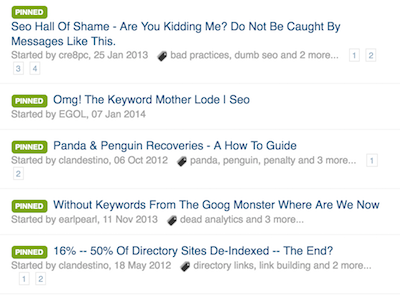
Cre8asite Forums


Even though this forum isn't extremely active anymore (there are a few new posts here every once in a while, but scroll about half way down the first page on most of their forums and that's where the posts from 2016 end), it is still a great resource to browse.


I don't want to say this website is “dead” but you're probably not going to get super up-to-date info here. Nonetheless, it is worth a mention because of its historical value.


Most SEOs try to do a good job staying updated on current topics, but reading what the industry was talking about in the past can be a great way to learn new things too.


At the very least, this forum is a giant rabbit hole to topics you may not have explored before. For as much as SEO changes nearly every day, it's also surprising how much of the conversations have remained the same. Find some threads from before you started working in SEO and I promise you'll learn something new browsing here.


cre8asiteforum


This list started off much more extensive, but I managed to whittle it down to a handful. If a site could be found easily by Googling “SEO blogs” I removed it.


If they had a lot of social media followers, I removed them. If they were ad-heavy or otherwise blatantly promotional, I removed them. If they've been listed in a lot of “SEO resources” posts already, I removed them. You get the idea.


If there are any you think I missed, please let me know because I would love to know about them.


Anthony Randall is a link building dude at Rizolt.com and contributor to SEW.