Thursday, January 21, 2016

SEO basics: 22 essentials you need for optimizing your site

Here we’ll take a look at the basic things you need to know in regards to search engine optimisation, a discipline that everyone in your organisation should at least be aware of, if not have a decent technical understanding.

One of our most popular articles of all time is a post entitled SEO Basics: 8 Essentials When Optimizing Your Site. It still does the business for us in terms of traffic, however it was first published in April 2013, so you can treat this as its long overdue and expanded update.

What is SEO?

Quite simply, SEO is the umbrella term for all the methods you can use to ensure the visibility of your website and its content on search engine results pages (SERPs).

The methods vary from technical practices you can achieve behind the scenes on your website (we tend to refer to this as ‘on-page SEO’) to all the promotional ’off-page’ approaches you can use to raise your site’s visibility (link-building, social media marketing).

For the purpose of this article, when we talk about visibility, we mean how high up the SERP your website appears for certain search terms in the ‘organic’ results. Organic results refer to those that appear naturally on the page, rather than in the paid-for sections…
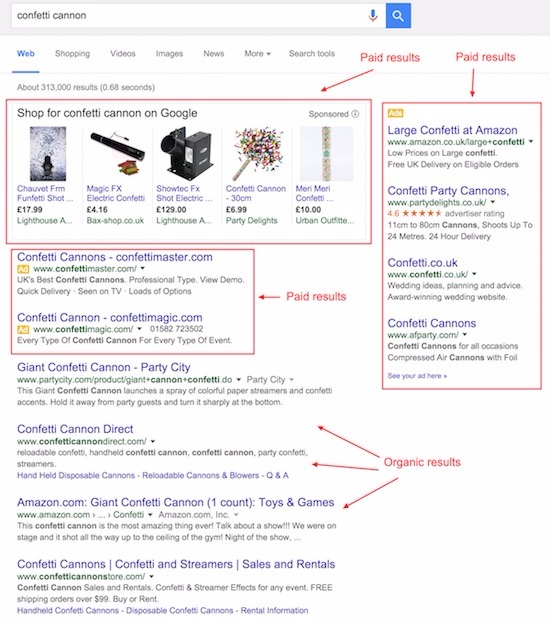
search for confetti cannon showing organic and paid results

Paid search is also a large part of search engine marketing. You can read more about this in our recent beginner’s guide to paid search and PPC.

Why do you need SEO?

Building a strong site architecture and providing clear navigation will help search engines index your site quickly and easily. This will also, more importantly, provide visitors with a good experience of using your site and encourage repeat visits. It’s worth considering that Google is increasingly paying attention to user experience.

When it comes to how much traffic is driven by search engines to your website, the percentage is substantial, and perhaps the clearest indicator of the importance of SEO.

In 2014, Conductor suggested 64% of all web traffic comes from organic search, compared to 2% from social, 6% from paid search, 12% direct and 15% from other referral sources.

This tallies with our own data, with approximately 70-75% of SEW traffic coming from organic.

Of all organic traffic, in 2015 it was found that Google accounts for more than 90% of global organic search traffic. So obviously you need a strong presence on Google SERPs, but how strong?

Well, according to this study from Advanced Web Ranking (which I’ve trotted out before when discussing how to dominate Google) shows that on the first SERP, the top five results account for 67.60% of all clicks and the results from six to 10 account for only 3.73%.
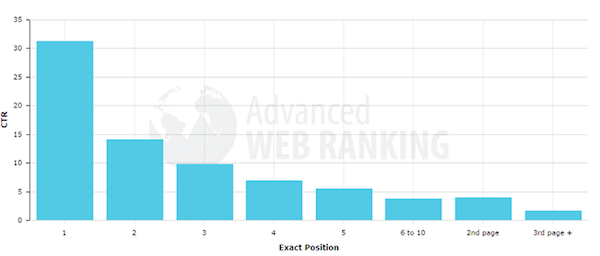
ranking positions chart

It’s therefore vital that your site appears in the top five results.

How are you going to achieve this? With the following tips, which I’ve split into two categories: what search engines are looking for and… drum roll… what they’re not looking for.

What are search engines looking for?

1) Relevancy

Search engines try to provide the most relevant results to a searcher’s query, whether it’s a simple answer to the question “how old is Ryan Gosling?” (the answer of which Google will likely provide without you having to leave the SERP) to more complicated queries such as “what is the best steak restaurant nearest to me?”
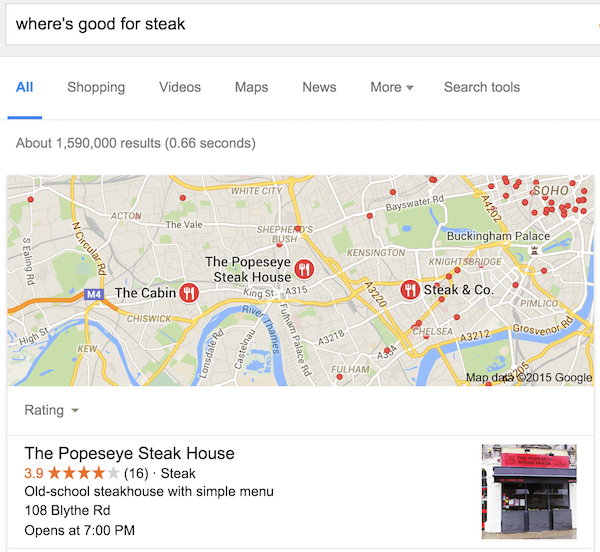
where's good for steak search

How search engines provide these results is down to their own internal algorithms, which we’ll probably never truly determine, but there are factors that you can be certain will influence these results and they’re all based around relevancy… For instance: a searcher’s location, their search history, time of day/year, etc.

2) The quality of you content

Do you regularly publish helpful, useful articles, videos or other types of media that are popular and well produced? Do you write for actual human beings rather than the search engine itself? Well, you should. Latest research from Searchmetrics on ranking factors indicates that Google is moving further towards longer-form content that understands a visitor’s intention as a whole, instead of using keywords based on popular search queries to create content.

Basically, stop worrying about keywords and focus on the user experience.

3) User experience

There are many SEO benefits for providing the best possible user experience. You need an easily navigable, clearly searchable site with relevant internal linking and related content. All the stuff that keeps visitors on your webpage and hungry to explore further.

4) Site speed

How quickly your webpages load is increasingly becoming a differentiator for search engines. Google may soon start labelling results that are hosted on Accelerated Mobile Page (AMP) so this may possibly be the ‘mobilegeddon’ of 2016. Speaking of which…

5) Cross-device compatibility

Is your website and its content equally optimised for any given screen size or device? Bear in mind that Google has stated that responsive design is its preferred method of mobile optimisation.

6) Internal linking

We’ve talked about the benefits of ensuring your site has clear and easy-to-use navigation, but there’s also a practice that editors and writers can carry out when publishing articles to help push traffic around the site and that may lead to higher trust signals for Google: internal linking. (See what we did there.)

Internal linking has many advantages:

  • It provides your audience with further reading options. As long as they’re relevant and you use clear anchor text (the clickable highlighted words in any give link). This can help reduce your bounce rates.
  • It helps to improve your ranking for certain keywords. If we want this article to rank for the term ’SEO basics’ then we can begin linking to it from other posts using variations of similar anchor text. This tells Google that this post is relevant to people searching for ‘SEO basics’. Some experts recommend varying your anchor text pointing to the same page as Google may see multiple identical uses as ‘suspicious’.
  • It helps Google crawl and index your site. Those little Googlebots that are sent out to fetch new information on your site will have a better idea of how useful and trustworthy your content is, the more they crawl your internal links.

7) Authority

An authority website is a site that is trusted by its users, the industry it operates in, other websites and search engines. Traditionally a link from an authority website is very valuable, as it’s seen as a vote of confidence. The more of these you have, and the higher quality content you produce, the more likely your own site will become an authority too.

However as the aforementioned Searchmetrics research suggests, year-on-year correlations between backlinks and rankings are decreasing, so perhaps over time ‘links’ may not be as important to SEO as we once thought.

There’s a good argument raging in the comments to this recent piece on links as a marketing KPI, which offers some diverse views on the subject.

8) Meta descriptions

Having a meta description won’t necessarily improve your ranking on the SERP, but it is something you should definitely use before publishing an article as it can help increase your chances of a searcher clicking on your result.

The meta description is the short paragraph of text that appears under your page’s URL in the search results, it’s also something you should have complete control of in your CMS.

Here it is in WordPress:

meta description in wordpress

Write succinctly (under 156 characters is good), clearly and make sure it’s relevant to your headline and the content of the article itself.

9) Schema markup

You can make your search results appear more attractive by adding Schema markup to the HTML of your pages. This can help turn your search results into a rich media playground, adding star-ratings, customer ratings, images, and various other bits of helpful info…
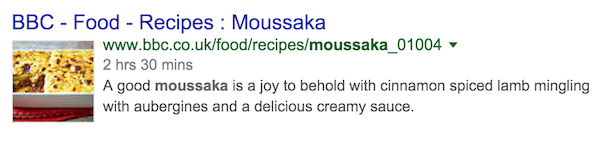
schema markup for recipe

Schema is also the preferred method of markup by most search engines including Google, and it’s fairly straightforward to use. For more information, check out our handy guide to Schema.

10) Properly tagged images

Many people forget to include the alt attribute when they upload images to their content, but this is definitely something you shouldn’t overlook because Google cannot ‘see’ your images, but can ‘read’ the alt text.

By describing your image in the alt text as accurately as possible it will increase the chances of your images appearing in Google Image search.
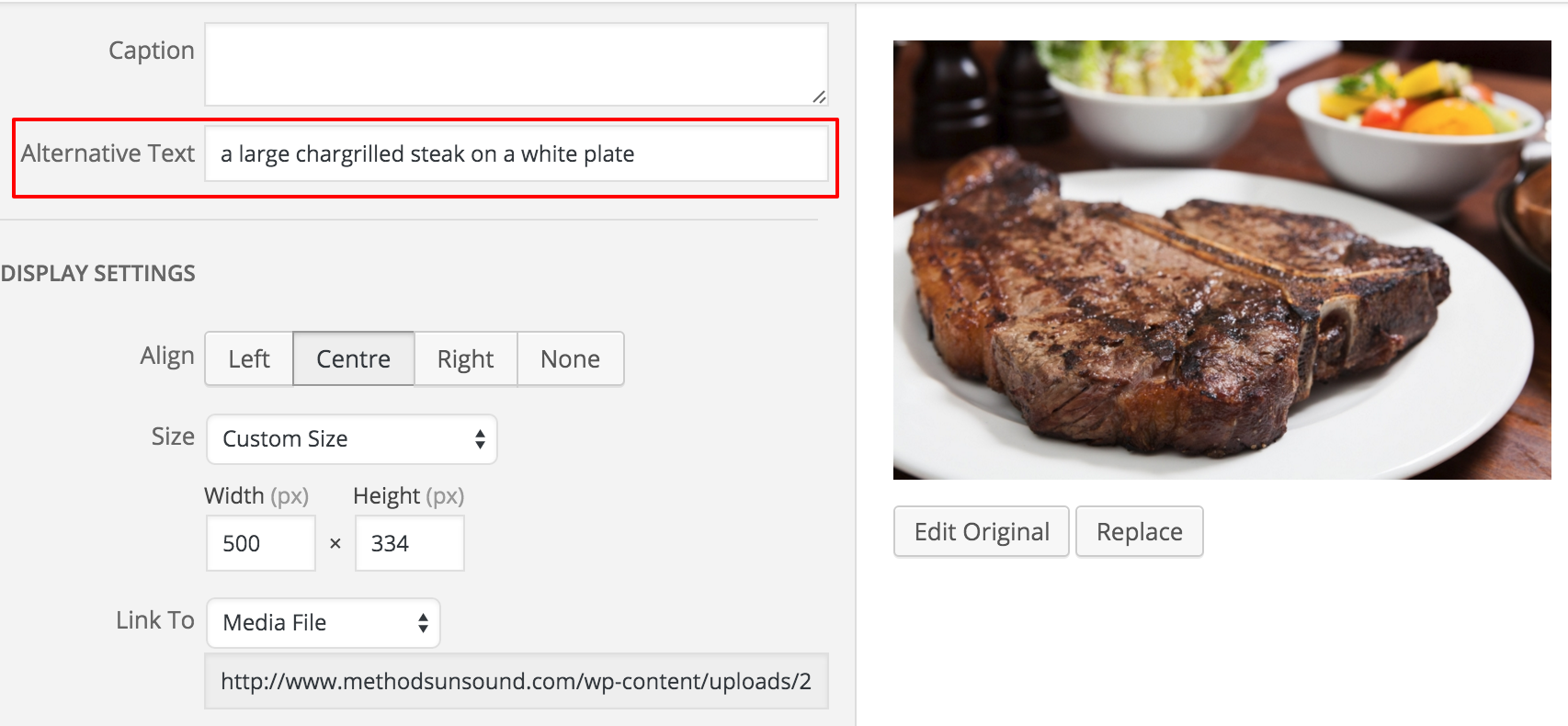
alt-text example in wordpress

It will also improve the accessibility of your site for people using ‘image reader’ software.

11) Evergreen content

Instead of peppering the internet with a rash of ‘quick win’ news stories with little insight, why not publish more evergreen content.

More thoughtful, helpful and practical-advice based articles can lead to huge long-term wins in terms of driving traffic and occupying highly visible positions in the SERPs.

Here’s a guide to planning and creating evergreen content.

12) Domain names

You should use sub-directory root domains (searchenginewatch.com/category/seo) instead of sub-domains (searchenginewatch.category.seo.com) as this is better for your overall site architecture.

You should also stay away from hyphens (search-engine-watch.com) and alternative Top-level domain names (.biz .name .info) as these are considered spammy.

Having a ‘keyword rich’ domain name may lead to closer scrutiny from Google. According to Moz, Google has “de-prioritized sites with keyword-rich domains that aren't otherwise high-quality. Having a keyword in your domain can still be beneficial, but it can also lead to closer scrutiny and a possible negative ranking effect from search engines—so tread carefully.”

Also you should make sure that if you operate a site without the www. prefix, someone who types in www.example.com will still be redirected to your site. If this isn’t happening, Google may assume these are two different sites and your visibility could be compromised.

13) Headlines and permalinks

The headlines for your articles should be under 55 characters to ensure their complete visibility in SERPs. Make sure they’re snappy, attractive and as descriptive as possible (this is often an impossible balance). Just stay away from clickbait headlines, do not promise something that the content doesn’t deliver.

The permalink (which you can normally alter in your CMS even after it’s been automatically set) doesn’t necessarily have to match the headline exactly. Google has stated that you can use three to four key words that you should put the most important keywords first.

14) Comments

Do not turn off your comments system. Having a thriving community of regular commenters engaging in dialogue under your posts shows that visitors care enough about your content to either make their own relevant points or to praise it or to ruthlessly eviscerate it. Either way, at least people are reading it.

Just be super-mindful about filtering out spam comments, or immediately removing any that slip through. It’s also worth adding the nofollow value to your comments section so Google ignores any erroneous links that may appear.

15) Local SEO

Increasingly Google is serving results to users based on their location. This is particularly important to businesses out there in the real world who ned to catch a searcher’s attention just at the right moment, i.e. while walking down the street, on their mobile and looking for somewhere to eat.

You should register with Google My Business and ensure that all of your information is accurate and up-to-date, such as opening times, contact information, customer reviews and that your categorised correctly.

16) Social

The most obvious way that you can raise your site’s visibility through non-technical SEO means is of course through social media marketing.

You need to make sure you’re present on all relevant social channels (wherever your audience may be), and not just broadcasting your content in a faceless manner, but by using it as a customer service channel and genuinely interacting with people in a friendly, helpful and entertaining manner.

The actual correlation between social signals and search rankings is a much argued over subject, but here’s a good overview of the subject.

What are search engines NOT looking for?

There are many ‘black hat’ practices that can bring the full weight of a Google penalty down on your site, so it’s best to avoid doing the following, even if it looks like a brilliant easy win at the time.

17) Keyword stuffing

Overusing keywords on your pages, especially when they obviously affect the readability of your site. It’s debatable whether Google even still uses keywords as a ranking factor anymore.

18) Link buying or excessive link exchanging

Thinking of approaching a link farm? Just don’t do it. It’s not even worth it. The most valuable links to your site are the ones that come from authority sites within your own niche.

19) Annoying ads

Anything overly intrusive that destroys the pleasure of reading your content and slows down your site speed.

20) Mobile app interstitials

If you present mobile visitors with a full-screen advert to download your app, Google will consider you no longer mobile friendly.
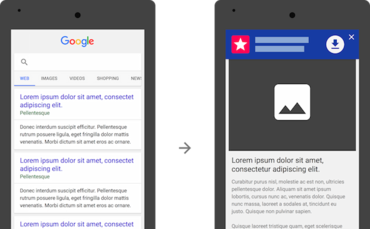
app ad interstitials

21) Duplicated content

If Google finds two identical pieces of content, whether on your own site, or on another you’re not even aware of, it will only index one of those pages. You should be aware of scraper sites, stealing your content automatically and republishing as your own. Here’s Graham Charlton’s thorough investigation on what to if your content ends up working better for somebody else.

22) Hidden text and links

There are a ways to manipulate rankings that a user may not ever see, but Google will probably find and punish you for.

Stay away from using white text on a white background, positioning text off-screen, setting font size to zero or hiding a link in a single character like a comma or a full-stop.

The temptation to put a link in that last full stop was incredibly high.

Right, on that note, I’ll finish up. Clearly this isn’t everything that you can do to help your initial SEO efforts, but it’s a good grounding at least

Please let me know if I’ve missed anything vital or just got something plain wrong…

Is Google Judging You Based on a Template?

Posted by ajfried

Thinking in templates

We all judge people on first impressions. When we see someone for the first time, we're quick to decide what type of person they are — based on the clothes they wear, how they style their hair, and anything else we notice that immediately puts them in a group.

It’s certainly not fair, but it’s human nature. And I'd like to keep my faith in humanity and argue that lots of us try NOT to prejudge others.

Google is judging you

Believe it or not, Google is the same. It judges, too. Some might disagree with this theory, but our internal research supports it, as you'll see in the data below. Google pre-classifies every single search term into a group for later recall.

Is that fair?

Is Google fair about how it does this?

Imagine, for a moment, that you're about to walk onto the stage of MozCon. You've spent months preparing and you have new and thought-provoking research to share. You are legend and you're about to blow everyone’s mind. And as you make your way up... SPLAT! You fall right on your face. I mean, really wipe out.

I7tRS2.gif

You'll probably recover, because you're dynamic and you'll still nail your presentation. However, you'll also be forever stamped as the one that fell on your face during the conference.

Is it fair that people treat us this way? Or how about Google? Is it fair that Google judges us like this, that we're classified into select groups, or that Google may show years-old negative content about us or our clients?

I think most people would agree: it’s not. Something that's truly not relevant to an individual's or brand’s storyline shouldn't be appearing prominently in a query for their name. An event that's nothing more than a blip on the radar shouldn't become the most important thing you see about them.

Yet, often it is. More often than you think. Some of the biggest brands in the world are dealing with this problem — having unfavorable content appearing for their name — and desperately try to get rid of it.

How does Google feel about ranking content?

On Google’s About page, Larry Page describes a perfect search engine as something that "understands exactly what you mean and gives you back exactly what you want."

As an example, it states: "This means making search smarter and faster, so it can understand that when you type in [jaguar] you’re looking for the car, not photos of the animal."

Well, first of all, they might want to find a different example, because queries without context can't hint at intent, as you'll see below.

Intent is really difficult

It’s a basic issue of not knowing what the context is for the query. And, arguably, some of the most important searches don’t have context. A brand? An individual? There's nothing necessarily unique about these searches to give them context. For example, if I search for "Applebee's" from my phone, there's context behind it. I'm on my phone, I'm in the vicinity of a restaurant, I'm probably hungry. But a query for, say, a gentleman named "James Young" is useless, as it gives Google no context or basis for figuring out which results might be most relevant. Do I want to know where he lives? When he was born? What kind of work he's in?

Tweet this! Arguably, these queries without context are the most important queries, and they're where audiences form opinions about brands. [Tweet this]

So, is Google out to get you?

Sometimes, it can seem like it is when your search results don’t reflect who you are or the content you're putting out into the world. Truth is, though, Google's probably not out to get you — in reality, it's an emotionless machine.

As I've mentioned previously, I don't believe it's evil. I think it's a machine controlled by an algorithm, with imperfections and flaws. Choices must be made based on the information available. Sometimes there isn’t enough to work with, or the right information that it'd like to show is missing, so it makes the wrong choices.

So... How do we change what Google wants to show?

Learning from Google’s templates

Google’s job is to show you what you're looking for. This can only be done by finding patterns and trends. Behind all the search results are templates that every query needs to fit in to.

When you perform a search in Google, you're effectively seeing whatever information it wants to show you on that day. It's a ton of information — but it’s not data. If you're able to collect all that information and trend it, an unbelievable amount can be learned.

For example, among the top 100 hedge funds:

  • 74% have their homepage at position 1
  • 72% have a knowledge graph
  • 38% have Wikipedia at average position 4.41
  • 74% have LinkedIn on page 1

Having this data, you start to uncover a deeper meaning behind the search results. You expose the template Google has created for this "type" of query. It should come as no surprise that these templates will change from industry to industry.

Understanding search result templates and trends by industry

The graph below gives a breakdown of what shows up in search results for these industries. (Note: the percentages are the percentage of Google page 1 results.)

Some notable observations:

  • Telecommunications companies have more results that are corporate on page 1 of Google than pharmaceutical companies do.
  • Pharmaceutical companies will have significantly more media content appearing in their search results than an engineering/construction company.
  • Food/drug stores don't usually get stock quotes appearing in their results.

Using data to create the content Google wants to show

Armed with this information, you can now identify what kind of content Google wants to show for you or your brand.

While we've all heard a million times that "content is king" and we should create more content, the reality is that only the RIGHT content is what’s going to make the difference. Content is not churning out post after post after post of products and other junk. Rather, content is about creating an impression that enhances the brand in the viewer's mind.

Practically, this idea of templates becomes extremely important in planning the right content for your brand. If you can use these templates to identify certain trends appearing for brands similar to your own, you can create the content Google wants to show.

Case studies and analysis

To help articulate this point, I want to share a few case studies.

Case study #1: The not-for-profit president that seems unfavorable

Take, for example, a client we had in the not-for-profit industry. He was the president of an organization and notable enough to have a Wikipedia profile, as did all of his competitors. His corporate site and social profiles were ranking relatively consistently with everyone else, and he authored content regularly. However, he had a disproportionate amount of media coverage about him compared to his competitors, causing negative content to rank prominently.

What became clear was that all the authored content was on his corporate sites, as opposed to a leading industry publication. Content creation was happening, but it was being put in the wrong place. According to the data, someone like this individual should be generating content on reputable industry publications.

Result: We worked to migrate some of his content to relevant publications. With a few relevant links, it began ranking within a few weeks.

Case study #2: The CEO gets all the news!

Another example was the CEO of an asset management company who had a disproportionate amount of news content appearing about them, some of which was negative. This caused frequent changes to the search results for the individual's name and a lack of branding around their name.

When you examine the results closer, you notice that on average, the CEO of a company like this would have two non-owned, executive-style profiles on sites like Forbes, Bloomberg, or Fortune.

Result: This individual was missing from notable lists, specifically the Forbes billionaire list. Working with the communications team, he was included in the list, displacing some of the negative content.

Case study #3: The need for more ownership

The final example I'll offer was of a client who had been trying to brand themselves through the use of content, blogging, press releases, and other similar information.

The biggest problem they had? They already had a nice amount of “ownership” within their search results. That means they had full and total control over half of the results appearing. Based on the peer analysis, it was going to be highly unlikely that they'd get more than that.

However, when we ran a frequency analysis, we noticed that every single one of their competitors has a GuideStar profile appearing.

The only differentiator between our client and their competitors was the level of their profile, which is earned by completing it. They were at silver, while everyone else had gold status (Note: there's some speculation about the level of status).

Once we helped them build up their profile to gold, we added a few easily-attainable and relevant links pointing to the profile. Easy ones, like from their corporate website. It doesn’t get more legit than that.

Result: Within a matter of weeks, we saw the profile ranking at the bottom of page 1, displacing negative content about the brand.

Practically using this information

At the end of the day, Google is nothing more than an organized system. We sometimes give it too much credit because it happens to be REALLY good at understanding what we want and mean. But this is based on an organized understanding of how we (all humans that use Google) use the search engine.

Not all content can rank for all types of queries. Just because a certain result appears for one query doesn’t mean that another will; randomly creating a bunch of profiles is not going the solution. For example, if you happen to be one of the 200 richest Americans in the world, Pinterest is not likely to rank for you. (It appears for 3 of them on page 2: Randa Williams, Milane Frantz, and H. Ross Perot Sr).

Using historical and competitor analysis, understanding what type of content is frequently appearing will give you tremendous insight into the kind of content you should be building to fit into the template Google has built for your brand.

One final note

The only loose end in this process is the thought that you're now "stuck" in a template. Once Google perceives you a certain way, is that it? Are you stuck? Can the CEO who loves arts and crafts convince Google that Pinterest should rank prominently for queries with their name?

There is some subjectivity to this, to be sure, but the entire process above is by far the path of least resistance. This is the content Google wants to show for queries about you or your brand, based on trends of others in your industry.

If you create an experience on that network that's highly popular, engaging, and something in which you invest a lot of time and effort, I think it's fair to say that it could change how search engines classify you. But convincing someone to blog or use social media when it’s not something they'll do aggressively or passionately usually doesn’t end well. Most people have these profiles, but that doesn’t mean they actively use them.

These templates exist because of the type of information that typically shows for these queries. It’s low-hanging fruit. If you have info that doesn’t make sense for who you are, it likely won’t appear right away without really hard work.

Work with the algorithm and make sense of which content it's clear that the search engine wants to show. If you create that content, it will rank.


Sign up for The Moz Top 10, a semimonthly mailer updating you on the top ten hottest pieces of SEO news, tips, and rad links uncovered by the Moz team. Think of it as your exclusive digest of stuff you don't have time to hunt down but want to read!

Wednesday, January 20, 2016

How to plan and create evergreen content

Last week I looked at the potential of evergreen content for SEO purposes, showing how it can work over time. 

This time I'll look at how to plan and create content like this, where to find ideas, and the different formats you can use.

Planning and idea generation

Ideas for content come from a range of sources, but here a few places to look for inspiration…

Matching your product to the content

Part of the challenge around evergreen is the nature of the product or service you're looking to draw attention to.

For Search Engine Watch this isn't too tricky. We're about providing advice and insight into (primarily) search marketing, so that's what we do.

However, it isn't so easy for some businesses. Exciting brands like Lego can create (or get their fans to create) content easily thanks to the product.

But what if you're selling pest control solutions, or insurance?

The deBugged blog from pest control firm Ehrlich is one example. Content such as guides to termites is evergreen, while there's also some playful posts, insect brownie recipes for one.

debugged

Identify common user/customer problems

This is a great starting point for content creation as it ensures that the focus is on solving genuine issues.

Take a look at this from Repair Clinic. Its drop-down menus allow customers to navigate according to the problem they're experiencing.

Repair clinic nav

Now, this is a useful way to navigate, but it also reveals something about the process of creating content.

Either from keyword research, or more likely an analysis of common customer questions and issues, Repair Clinic has identified some of the reasons customers look for repair information.

It has then created the page to match the query, and produced some useful resources for customers.

From an SEO perspective, it works beautifully. I've taken a few of the common problems from the drop-down menu, and invariably you'll see Repair Clinic in a prominent position.Repair Clinic SEO

So, Repair Clinic has found common user problems and created content which addresses those issues.

The fact that this content is easy to find in the SERPs should ensure that the company attracts plenty of relevant traffic, and sells a few spare parts.

Mining your data

Ideas for content are all around, and many are there in your site's data.

For example, you could look at your site search data for common queries and issues which content could address.

Do your users' on-site searches reveal issues that haven't been addressed by your current content? Do any topics stand out?

What has worked before?

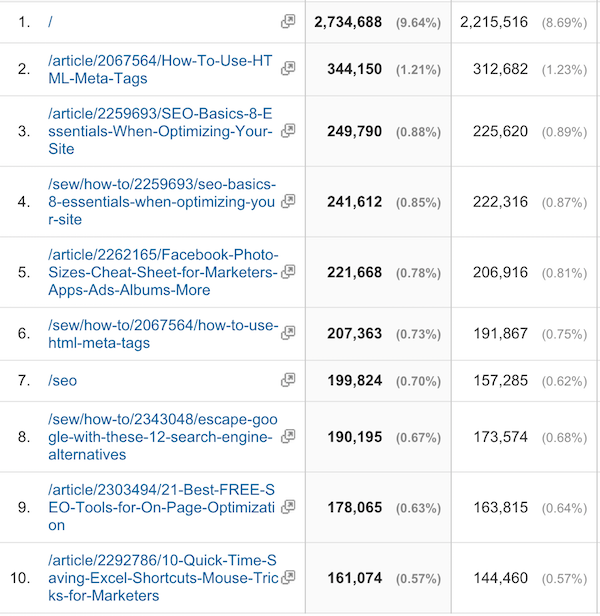
Look back through analytics data. Identify the evergreen posts you already have on your site.

This is easy enough, just take a look at the top content fro the last year or two. Are there posts with recurring traffic over that period?

ga evergreen

Evergreen content should look something like this:

evergreen meta tags

As we can see, it's receiving a consistent amount of traffic over a long period of time, just over a year in this case.

It doesn't necessarily have to be huge amounts of traffic. If the content is relevant to your products or services, the important thing is that it's attracting the right kind of visitors.

Once you've identified your own evergreen content, think about what these pages have in common:

  • Headlines. Is there a pattern? In our list above, and other reports, common factors include compelling headlines, lists, and how-to guides.
  • Topics. What are the common themes and topics that perform well?
  • Article style. Are they stats based articles? Infographics? Long-form content?
  • Presentation. How are articles presented? I find lots of relevant charts, example screenshots and clear headings make an article more readable and hence more likely to become evergreen.

Look at social data

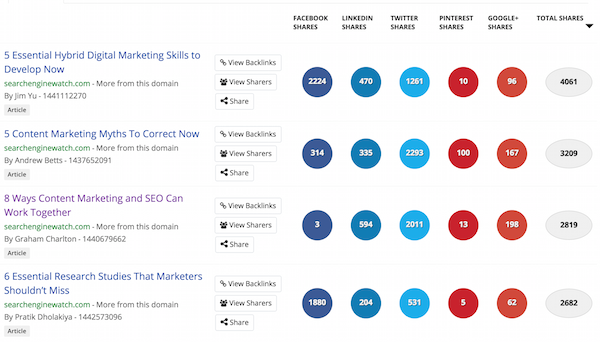
Using social tools such as buzzsumo you can identify the posts that perform well over time on social media.

This doesn't necessarily equate to consistent traffic, but it quite often does and provides more inspiration.

Buzzsumo SEW

Search rankings

See which terms you're ranking for and which pages are ranking well for those terms.

This should help you to identify the evergreen content that is already working, as well as providing ideas for new content.

seo evergreen

For ideas, I'll often look for search terms where there is room for improvement. Maybe terms where rankings have slipped due to older content, or where we're near the top of page two.

Updating and keeping content fresh

An easy way to create evergreen content, and one which follows on from the previous points, is to refresh and rewrite existing evergreen pages.

We've done this once or twice with SEW content. For example, this Facebook cheat sheet article from 2013 has been consistently popular, but the information within will change over time.

So, we created a social media image size infographic with more up to date information. It was published in December, so it's early to judge whether or not it will be evergreen, but it has been popular so far.

Some sites will simply update the content and republish posts as new. It's a tactic which can work and something I've experimented with in the past.

In short, with an update and a new publish date, you can attract extra traffic, links and shares, and it can boost the rankings for that page as Google sees fresh rather than refreshed content.

However, I find it more honest and transparent, and more useful for readers, to create new articles based on older content. You can always use the older pages to link to the new version, and vice versa.

Evergreen content formats

These article formats have worked well, and can be adapted for different sites and topics.

Go niche

Don' be afraid to get into the detail on posts. Evergreen content isn't all about popularity, it's about delivering the right kind of traffic over time.

For example, a post on using redirects may seem niche to some, but for a site like this it can deliver consistent long tail traffic.

e.g: Guide to 301 redirects for SEO

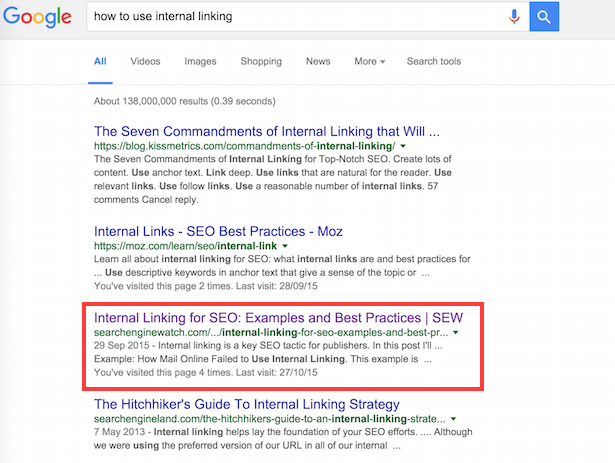
How-to guides

How to guides fit very well with this site's ethos, and work well over time as they provide practical guidance for users.

They also perform well in search for the same reason, as well as the fact that people will often append searches with ‘how to'.

seo internal linking

E.g: Internal linking for SEO: examples and best practices

Curation

Listing useful tools or stats adds value for users and creates a useful resource which keeps people coming back.

For example, this post on free SEO tools has been in the top 10 SEW posts for the past couple of years.

Lists

Some people may dislike them, but the truth is that lists work very well.

Indeed, they make up roughly 70% of our most popular articles over the past few years.

They work principally because they tell the potential reader that they will be easy to scan and digest, and also appeal to people's curiosity.

E.g: 14 ways to reduce your site’s bounce rates

Go long-form

Longer articles tend to be more comprehensive and can provide readers with much of the information they need on a given subject.

There is a belief that the internet has destroyed people's attention spans, and that longer articles are to be avoided, but I don't subscribe to that.

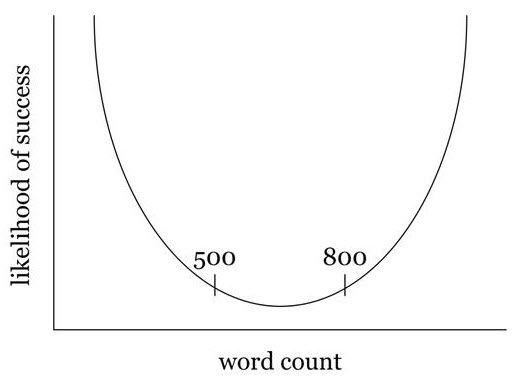
Indeed, the Quartz curve is a good example. it found that articles of between 500 and 800 words weren't performing as well.

The reason? More than 500 words but less than 800 is too long to be easily digestible yet too short to be in-depth. It's a kind of no-man's land.

quartz curve

While the exact word counts may differ, I've seen the same thing on sites I've worked on. So, this article is 1,336 words long…

In summary

There isn't necessarily a magic formula for creating evergreen content, its more something to aim for.

You can create a comprehensive guide to a topic but, for various reasons, sometimes they just don't work over time.

However, if you attempt to produce quality content with an eye on SEO that aspires to be evergreen, you'll get there a lot of the time.

Tuesday, January 19, 2016

Introducing a new real-time marketing metric: ‘EvE’ (effort vs engagement)

Does the world really need another metric to measure performance? Unfortunately, I think we do, as one of the biggest issues in marketing is a lack of agility. We need new metrics to help speed up our reaction times.

With that in mind, allow me to introduce ‘EvE’, which is a loose, ill-defined, highly immature real-time marketing metric. I’d love some feedback as this is very much a work in progress.

EvE is a measure of how much bang you’re getting for your buck. You want maximum bang for minimum buck. In most cases, time is money, and effort / time can be measured in cold hard cash. Are your efforts paying off? Is there anything you can do to ensure success?

I’ve always had some sense of whether the thing I’ve worked on has underperformed, or outperformed, and increasingly I monitor this in real time, mainly because it’s possible to do so. I’m really just trying to figure out if something was worth the effort.

I instinctively use ‘EvE’ thinking primarily to measure content marketing, but it applies to marketing more broadly, as well as things like conversion rate optimisation, and UX. In fact, it applies to all kinds of things.

EvE could also apply to that three-course meal you’re going to lovingly prepare for your dinner guests. If it goes right, you’ll hear a lot of comments about how delicious it is, and how lovely it smells, and how did you make it, and where did you find such incredible ingredients, and oh we must really come over more often!

If it goes badly, there will normally be a few polite murmurings, and then silence. You’ll wish you just ordered pizza. Cooking really wasn’t worth the bother, nor the expense, and you could have spent the afternoon doing something else.

keith floyd

That’s EvE in a nutshell. You want people to come over more often and to say nice things about your efforts, and to feel like it was a worthwhile endeavour.

It’s a bit like that in business, don’t you think? You want lots of repeat customers who do your marketing for you by becoming advocates, and recommending your products and services (the most powerful form of marketing there is).

Why we need something new

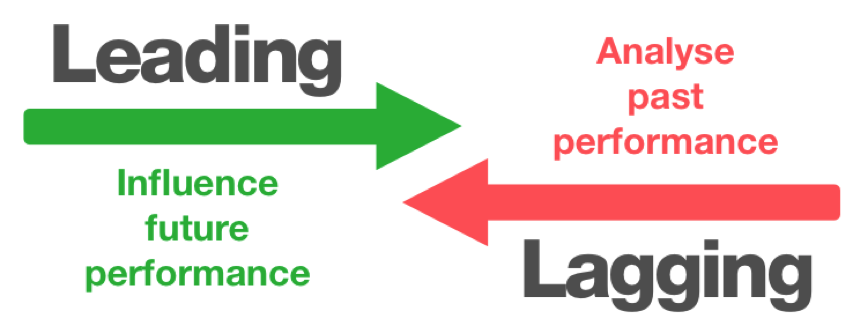
There are dozens of ways to measure success, but many of them are lagging indicators. In other words, they reflect the state of play once the results are in. This is all very well, but we need more leading indicators in our lives.

Leading indicators help us to predict future success, or warn us about imminent failure. All kinds of leading indicators are used by goal-orientated people to see if they’re on-course, or heading for the rocks. They give us the opportunity to react.

leading indicators

EvE is a blend. It is one part lagging indicator (‘effort’) and one part leading indicator (‘engagement’), but over time I think it will become much more aligned to the latter, as engagement (which is broadly a synonym for ‘performance’) can be measured in real-time.

For example, if this post achieves a certain number of social shares within a certain timeframe then I know it will be a hit, relative to other posts on this site. I also know that it will continue to attract shares (and page impressions, and comments, and new inbound links, etc) in the days and weeks ahead.

If, however, things go the other way, I can consider doing something about it. I could do some paid social, or get in touch with some of my influencer buddies to spread word. I could push it around to relevant link sharing sites. I could start a fight with somebody who I know will disagree with it. I could create a visualisation to explain EvE in less than 1,000 words. I could spin it out into other content formats, such as slideshows, webinars, videos, etc.

And so on.

Building momentum

What we’re really talking about here is engagement velocity. EvE seeks to measure engagement velocity in real time.

Content is ‘alive’ for a while, and at some point it will naturally fade out. Or at least that’s how it should be. If you’re busy creating content that doesn’t reach the average lifespan of an article, then you seriously need to consider whether it was worth the effort. Lifespan can be measured in impressions, comments, shares, downloads… whatever floats your particular boat.

You also need to spot the outliers and learn from them. Figure out why certain blog posts or videos outperform. More importantly, take a look at the ones that underperform, especially if you’re spending a lot of effort on them. If they don’t have a tactical value, then is it worth investing in any more of them? Remember that as the amount of effort increases, so must the engagement.

The EvE metric, if used in real-time as a leading indicator will help you spot whether or not something needs – or merits – a push. You can use it to predict performance, considering how something should be performing at any given point.

Sometimes you need to light a fire underneath your efforts. If you spend a month working on a new piece of content (or marketing campaign, or product feature, or 72-course dinner for your guests) then hopefully it will be good enough to attract enough attention to merit the effort. But, if needed, you can go the extra mile to promote it, unless it’s clearly a dud.

This is why EvE is different from ROI. It is meant to be more fluid, and less final. Real-time marketing is all about agility, and if you track EvE you should be in a position to move the ROI needle.

Calculating ‘EvE’

I don’t want to be too prescriptive with regards to scoring systems, but suggest that you can use absolute numbers, points, weighted averages, and multipliers to come up with some meaningful figures.

The key is to know a few things in advance. All of these things can be baked into your calculations.

Effort

  • The cost
  • The amount of time spent
  • Output
  • People

Cost is the primary – and most straightforward – measure of ‘effort’. When you’re ready to release a new piece of content you’ll have a pretty accurate sense of how much it cost. At this point, you’ve invested what it takes to produce and edit the content, and as such you’ll know what it takes for that effort to pay off. Cost is more easily measured when using freelancers, agencies and contractors.

Time spent seems straightforward on the face of it, and is an alternative to cost (though you can use both). Time is inherently linked to cost, but is perhaps more useful for evaluating the efforts of in-house teams, especially if you don’t want to get into proportionate salary calculations. Was it worth spending an hour, a day, a week or more on that thing? Worth it, as in, should you do it again?

Output is the thing that was produced. Everything is relative. Different content formats have different costs, on average, and they perform differently. A video should be compared with a video, a blog post with a blog post. Adjust your benchmarks, targets and goals accordingly. It’s worth adding that some things are more aligned to your macro goals than others.

People. This follows on from ‘time spent’. What was the opportunity cost of that particular person doing that particular piece of work? What else could they have been working on? It is crucial that you use your team wisely, especially your star players.

Engagement

  • The real-time targets
  • The goal

Targets. How will you know if you’re on track? For content, real-time targets might be things like concurrent users onsite, or impressions or comments, or shares or likes, or influencer mentions, or inbound links, or downloads, or leads. What is par, one hour, one week, or one month after publication?

Goals can be strategic or tactical. This is very much a case of horses for courses. You’ll need to figure this out for yourself, thinking about the ultimate goals of your business. How is the thing you’ve worked on contributing to those goals?

You can track all of this stuff as it happens, and react as necessary.

A scoring framework

I think the best way to measure is EvE is to put together a scoring framework, based on average costs (effort) and average performance benchmarks (engagement). The higher the EvE score, the better.

EvE score = engagement divided by effort

A blog post might be given an effort score of 100. The effort reflects time and cost to produce the post, relative to other outputs (e.g. video = 500, whitepaper = 2,500, etc).

For that blog post to break even, it must also achieve an engagement score of 100. This is the anticipated performance, and value, relative to similar content. In other words, the goal.

Its EvE score is engagement divided by effort. In this case, that’s 100/100, which gives it an EvE score of 1. And that’s okay, because 1 is par.

The effort score

Using the above examples we can compare different outputs. A video costs five times as much effort to produce, vs a blog post. A whitepaper costs five times a video, and 25 times as much as a blog post in effort.

However, these are averages. 100 points is the average effort score for a blog post. That might be akin to three hours of a freelance writer’s time.

It could be that the same writer puts together a post in half of the time, and charges you half the fee. We can halve the effort score to reflect that.

The engagement score

Let’s say an average blog post pulls in 5,000 impressions. If a post hits that mark we can award it the full 100 points, and an EvE score of 1 (100/100 = 1).

If it underperforms and reaches just 4,000 impressions then it gets just 80 points, and an EvE score of 0.8 (80/100).

But let’s say it only took half the time to produce. We halve the effort score (to 50) and the EvE score rises to 1.6 (80/50). It took 50% less time and money but still achieved 80% of the goal. You still have resources at your disposal to chase down the other 20% (or more).

Real-time EvE

In a real-time environment, it gets more interesting. EvE becomes a leading indicator of ROI, rather than a relative calculation of ROI, which occurs after the fact.

For EvE to work in real-time, you need to set some targets (I like to think of them as checkpoints) and stay tuned-in as things unfold. By doing so you’ll be able to react, if you need to.

Social shares are a particularly strong leading indicator of content performance. Let’s say 400 shares after 24 hours is the average for par performance for a blog post. If your post accrues 800 shares you should be in for a good time. If you struggle to reach 100 shares then something may be amiss. You can adjust your real-time EvE scores accordingly.

Multipliers and weightings will come into play. 800 shares might be worth more than double, for example, as the network effect, buzz and viral momentum can propel a blog post much further than you think. And perhaps 100 shares isn’t quite as bad as you fear.

At this point the formula will probably need to be finessed on a case-by-case basis. What you track and how you score things will depend on your macro and micro goals.

Audit

There’s one other thing that EvE does: it makes you think about what’s working, and what’s not. In order to put a scoring framework together you need to undertake an EvE audit, to benchmark effort vs. engagement across all that you do.

There’s a bit more to say, but I’ll throw this out there now for feedback. Do let me know if you think it’s workable, or if you put together a real world example based on the above methodology.

I’d also be interested to hear of any other real-time marketing metrics and KPIs that you’re using as leading indicators of future success. I’m keen to explore this area in more detail.

Thursday, January 14, 2016

Does native advertising really work?

I’ll lay out my stall straight away, I don’t particularly like native advertising. However, I’m seeing this as an exercise in trying to dispel my own confirmation bias.

Wednesday, January 13, 2016

Why companies create content - Part one: to create and change perception

There's a lot written about how to plan, publish and promote content, but much less on the reasons for doing so in the first place.

What do you need to know about 'responsive content marketing'?

Content itself will soon be responsive . Text will actually change depending upon the device. Content will adjust automatically just as a responsive website would adjust to the device it is being displayed on.